

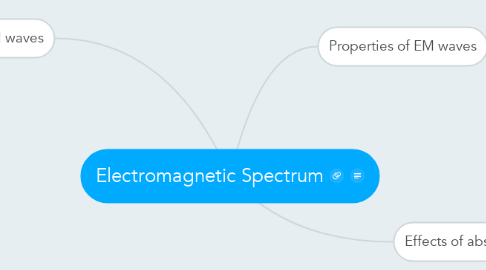
1. Types of EM waves
1.1. Radio Waves (1 x 10^8 Hz)
1.1.1. Produced by electron oscillations
1.1.2. Used in telecommunications
1.2. Microwaves ( 1 x 10^10 Hz)
1.2.1. Produced by special devices E.g. Klystron
1.2.2. Used in microwave oven and satellite communication
1.3. Infrared (1 x 10^12 Hz)
1.3.1. Produced by hot objects
1.3.2. Used in thermal imaging and remote controls
1.4. Visible Light ( 5 x 10^14 Hz)
1.4.1. Red light has LARGEST wavelength, LOWEST frequency
1.4.2. Violet light has SMALLEST wavelength, HIGHEST frequency
1.4.3. Used in optical fibres and telecommunications
1.5. Ultraviolet (3 x 10^16 Hz)
1.5.1. Produced by sunlight
1.5.2. Used in sterilisation of medical instruments and suntanning
1.6. X-rays (3 x 10^18 Hz)
1.6.1. Produced by high speed collisions of electrons with metals
1.6.2. Used in airport scanners and bone imaging
1.7. Gamma rays (3 x 10^20 Hz)
1.7.1. Emitted by nuclei of radioactive atoms
1.7.2. Used in cancer treatment
2. Properties of EM waves
2.1. Same velocity in vacuum (3.00 x 10^8 m/s)
2.2. Follow laws of reflection and refraction
2.3. Transfers energy, not electrical charge
2.4. Transverse waves
2.5. Follows wave formula v = fλ
3. Effects of absorption of EM radiation
3.1. Ionisation of living matter
3.1.1. Caused by UV, X-rays and γ rays
3.1.2. Damages cells and DNA
3.1.3. Causes cancers and foetus deformation
3.2. Infrared heating
3.2.1. Caused by IR radiation
3.2.2. Causes heating of cells