


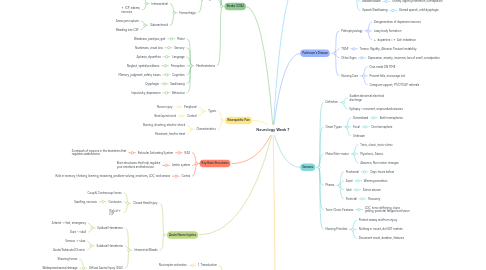
1. Parkinson's Disease
1.1. Pathophysiology
1.1.1. Dengeneration of dopamine neurons
1.1.2. Lewy body formation
1.1.3. ↓ dopamine = ↑ Ach imbalance
1.2. TRAP
1.2.1. Tremor, Rigidity, Akinesia. Postural instability
1.3. Other Signs
1.3.1. Depression, anxiety, insomnia, loss of smell, constipation
1.4. Nursing Care
1.4.1. Give meds ON TIME
1.4.2. Prevent falls, encourage ind.
1.4.3. Caregiver support, PT/OT/SLP referrals
2. Multiple Sclerosis
2.1. Pathophysiology
2.1.1. MS = immune system attacks myelin -> electrical transmission slows
2.2. Symptoms
2.2.1. Motor
2.2.1.1. Weakness, spasticity, balance/coordination issues
2.2.2. Sensory
2.2.2.1. Numbness/tingling, vision changes
2.2.3. Fatigue
2.2.3.1. Severe, overwhelming fatigue (most common symptom)
2.2.4. Cognitive
2.2.4.1. Memory and concentration problems
2.2.5. Bladder/Bowel
2.2.5.1. Urinary urgency/retention, constipation
2.2.6. Speech/Swallowing
2.2.6.1. Slurred speech, mild dysphagia
3. Seizures
3.1. Definition
3.1.1. Sudden abnormal electrical discharge
3.1.2. Epilepsy = recurrent, unprovoked seizures
3.2. Onset Types
3.2.1. Generalized
3.2.1.1. Both hemispheres
3.2.2. Focal
3.2.2.1. One hemisphere
3.2.3. Unknown
3.3. Motor/Non-motor
3.3.1. Tonic, clonic, tonic-clonic
3.3.2. Myoclonic, Atonic
3.3.3. Absence, Non-motor changes
3.4. Phases
3.4.1. Prodromal
3.4.1.1. Days-hours before
3.4.2. Aural
3.4.2.1. Warning sensation
3.4.3. Ictal
3.4.3.1. Active seizure
3.4.4. Postictal
3.4.4.1. Recovery
3.5. Tonic-Clonic Features
3.5.1. LOC, tonic stiffening, clonic jerking, postictal fatigue/confusion
3.6. Nursing Priorities
3.6.1. Protect airway and from injury
3.6.2. Nothing in mouth, do NOT restrain
3.6.3. Document onset, duration, features
4. Key Brain Structures
4.1. RAS
4.1.1. Reticular Activating System
4.1.1.1. A network of neurons in the brainstem that regulates wakefulness
4.2. Limbic system
4.2.1. Brain structures that help regulate your emotions and behaviour
4.3. Cortex
4.3.1. Role in memory, thinking, learning, reasoning, problem-solving, emotions, LOC, and senses
5. Pain Physiology
5.1. Pathway
5.1.1. 1. Transduction
5.1.1.1. Nociceptor activation
5.1.2. 2. Transmission
5.1.2.1. Spinal cord -> brain
5.1.3. 3. Perception
5.1.3.1. Conscious awareness
5.1.4. 4. Modulation
5.1.4.1. Brain inhibits pain
5.2. Nociceptors
5.2.1. Definition
5.2.1.1. Specialized sensory neurons that detect potentially harmful stimuli and send pain signals to the brain
5.2.2. Mechanical, thermal, chemical
5.3. Fibre Types
5.3.1. A-delta
5.3.1.1. Sharp, fast
5.3.2. C fibres
5.3.2.1. Dull, slow
5.4. Endogenous Opioids
5.4.1. Block neurotransmitter release
5.4.2. Attach to mu/kappa/delta receptors
6. Neuropathic Pain
6.1. Types
6.1.1. Peripheral
6.1.1.1. Nerve injury
6.1.2. Central
6.1.2.1. Brain/spinal cord
6.2. Characteristics
6.2.1. Burning, shooting, electric-shock
6.2.2. Persistent, hard to treat
7. Acute Neuro Injuries
7.1. Closed Head Injury
7.1.1. Coup & Contracoup forces
7.1.2. Contusion
7.1.2.1. Swelling, necrosis
7.1.3. Risk of ↑ ICP
7.2. Intracranial Bleeds
7.2.1. Epidural Hematoma
7.2.1.1. Arterial -> fast, emergency
7.2.1.2. Dura -> skull
7.2.2. Subdural Hematoma
7.2.2.1. Venous -> slow
7.2.2.2. Acute/Subacute/Chronic
7.2.3. Diffuse Axonal Injury (DAI)
7.2.3.1. Shearing forces
7.2.3.2. Widespread axonal damage
7.2.3.3. Long-term cognitive deficits
8. Stroke (CVA)
8.1. Definition
8.1.1. Brain cell death from ischemia or hemorrhage
8.2. Brain Blood Supply
8.2.1. Carotid
8.2.1.1. Frontal/parietal/temporal
8.2.2. Vertebral
8.2.2.1. Cerebellum, brainstem, occipital
8.3. Risk Factors
8.3.1. Modifiable
8.3.1.1. HTN, A-fib, diabetes, smoking, drugs
8.3.2. Non-modifiable
8.3.2.1. Age, sex, genetics, SDOH
8.4. Types
8.4.1. Ischemic
8.4.1.1. TIA
8.4.1.1.1. Temporary ischemia
8.4.1.2. Thrombotic
8.4.1.2.1. Clot forms in vessel
8.4.1.3. Embolic
8.4.1.3.1. Clot travels, sudden onset
8.4.2. Hemorrhagic
8.4.2.1. Intracerebral
8.4.2.1.1. Vessel rupture -> bleeding into brain tissue
8.4.2.1.2. ↑ ICP, edema, necrosis
8.4.2.2. Subarachnoid
8.4.2.2.1. Aneurysm rupture
8.4.2.2.2. Bleeding into CSF
8.5. Manifestations
8.5.1. Motor
8.5.1.1. Weakness, paralysis, gait
8.5.2. Sensory
8.5.2.1. Numbness, visual loss
8.5.3. Language
8.5.3.1. Aphasia, dysarthria
8.5.4. Perception
8.5.4.1. Neglect, spatial problems
8.5.5. Cognition
8.5.5.1. Memory, judgment, safety issues
8.5.6. Swallowing
8.5.6.1. Dysphagia
8.5.7. Behaviour
8.5.7.1. Impulsivity, depression