


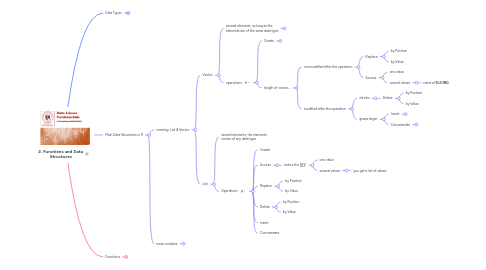
1. Data Types
1.1. Numerical
1.1.1. Real
1.1.2. Integer
1.1.3. Complex
1.2. Logical
1.3. Categorical
1.3.1. Nominal
1.3.2. Ordinal
1.4. Date
1.5. Character or String
2. Main Data Structures in R
2.1. creating: List & Vector
2.1.1. Vector
2.1.1.1. several elements, as long as the elements are of the same data type
2.1.1.1.1. it coerces elements so they all are the same type!
2.1.1.2. operations
2.1.1.2.1. Create
2.1.1.2.2. Access
2.1.1.2.3. Replace
2.1.1.2.4. Delete
2.1.1.2.5. Insert
2.1.1.2.6. Concatenate
2.1.2. List
2.1.2.1. several elements, the elements can be of any data type
2.1.2.2. Operations
2.1.2.2.1. Create
2.1.2.2.2. Replace
2.1.2.2.3. Access
2.1.2.2.4. Delete
2.1.2.2.5. Insert
2.1.2.2.6. Concatenate
2.2. more complex
2.2.1. Data Frame
2.2.1.1. Native in R
2.2.1.1.1. NO installation required
2.2.1.2. Basic Operations
2.2.1.2.1. Create
2.2.1.2.2. Access
2.2.1.2.3. Replace
2.2.1.2.4. Delete
2.2.1.2.5. Insert
2.2.1.2.6. other important operations (Python versus R)
2.2.2. Graphs
2.2.2.1. Non-native in R
2.2.2.1.1. Need to install **igraph**
2.2.3. Spatial Data Frame
2.2.3.1. Non-native in R
2.2.3.1.1. Need to install **sf**
3. Functions
3.1. why?
3.1.1. improve readability
3.1.1.1. Promote Code Reusability
3.1.2. abstract repetitive tasks
3.1.2.1. predictable code
3.1.2.2. Modular Development
3.1.3. hide complexity
3.1.3.1. Facilitate Debugging and Testing
3.1.3.2. Reduce Errors and Maintainability
3.2. Elements
3.2.1. Input
3.2.1.1. definition
3.2.1.2. parameters
3.2.1.2.1. arguments
3.2.1.2.2. defaults
3.2.2. Internal Execution
3.2.2.1. local variable
3.2.2.2. constants
3.2.2.3. global variable
3.2.2.3.1. use
3.2.2.3.2. avoid modifying
3.2.3. Output **return()**
3.2.3.1. value
3.2.3.2. values
3.2.3.2.1. list/vector/etc?
3.2.3.3. Implicit Return?
3.3. Applying to...
3.3.1. table
3.3.1.1. dataframe
3.3.2. column/row
3.3.2.1. vector
3.3.2.2. list
3.3.3. cell value