


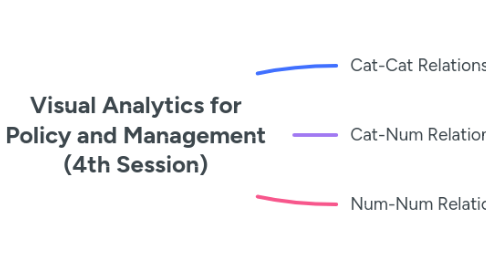
1. Cat-Cat Relationships
1.1. **Simple combinations**
1.1.1. PROCESS
1.1.1.1. Unit of Analysis: crime
1.1.1.2. Identify Type: Both Categorical
1.1.1.3. Informing Association
1.1.1.3.1. 1. Prepare Contingency Table
1.1.1.3.2. 2. Compute Marginal Percents by column
1.1.1.3.3. 3. Combine both into a Data Frame
1.1.1.3.4. 4. Choose the Right Plot
1.2. complex combinations
1.2.1. PROCESS
1.2.1.1. Unit of Analysis: crime
1.2.1.2. Identify Type: Both Categorical
1.2.1.3. Informing Association
1.2.1.3.1. 1. Prepare Contingency Table
1.2.1.3.2. 2. Compute Marginal Percents by column
1.2.1.3.3. 3. Combine both into a Data Frame
1.2.1.3.4. 4. Choose the Right Plot
2. Cat-Num Relationships
2.1. Days to Report and Precinct
2.1.1. PROCESS
2.1.1.1. Unit of Analysis: crime
2.1.1.2. Identify Type: One numeric other Categorical
2.1.1.3. Informing by Groups
2.1.1.3.1. 1. Prepare **Aggregation** by means (or medians)
2.1.1.3.2. 2. Explore group behavior with **boxplots**
2.1.1.3.3. 3. You will not to convert tables to data frames
2.1.1.3.4. 4. Choose the Right Plot
3. Num-Num Relationships
3.1. Num-Time
3.1.1. PROCESS
3.1.1.1. Unit of Analysis: crime
3.1.1.2. Identify Type: One numeric (time) but that repeats
3.1.1.3. Prepare frequency table with dates
3.1.1.4. Inform with plots
3.1.1.4.1. 1. Lines
3.1.1.4.2. 2. Histograms
3.1.1.4.3. 3. Boxplots
3.1.1.4.4. 4. Custom
3.2. Num-Num
3.2.1. PROCESS
3.2.1.1. Unit of Analysis: **Neighborhood**
3.2.1.2. Identify Type: Both numeric
3.2.1.3. Inform with plots
3.2.1.3.1. 1. Scatter plot
3.2.1.3.2. 2. Heatplots