Unlock the full potential of your projects.
Try MeisterTask for free.
¿No tienes una cuenta?
Regístrate Gratis
Navegar
Mapas Destacados
Categorías
Gestión de proyectos
Objetivos de negocio
Recursos humanos
Lluvia de ideas y análisis
Marketing y contenido
Educación y notas
Entretenimento
Vida
Tecnología
Diseño
Resúmenes
Otros
Idiomas
English
Deutsch
Français
Español
Português
Nederlands
Dansk
Русский
日本語
Italiano
简体中文
한국어
Otros
Ver mapa completo
Copiar y editar mapa
Copiar
Learning Objectives
TZ
tianye zhou
Seguir
Comienza Ya.
Es Gratis
Regístrate con Google
ó
regístrate
con tu dirección de correo electrónico
Mapas Mentales Similares
Esbozo del Mapa Mental
Learning Objectives
por
tianye zhou
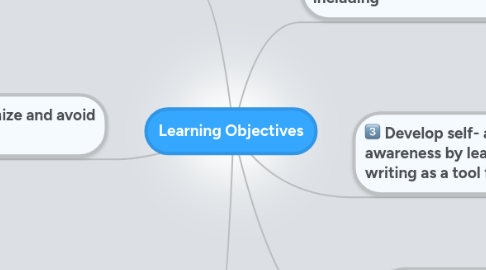
1. Learn to recognize and avoid plagiarism
2. Apply the process approach to the writing of a short research paper
2.1. Use critical reading and thinking to evaluate source material for accuracy, relevance, reliability, and credibility
2.2. Integrate source material into your writing
2.3. Use a variety of attribution techniques
2.4. Use different types of evidence
2.5. Use proper formatting for the style being used (APA or MLA)
3. Identify and use a process approach to writing by learning to
3.1. Generate ideas through free-writing, mind mapping, pair and small group discussion
3.2. Draft and revise independently
3.3. Give and receive feedback in peer evaluation exercises
4. Relate general writing skills to discipline-specific writing requirements
5. Develop self- and audience awareness by learning to use writing as a tool for
5.1. Discovering and exploring what matters
5.2. Aligning feelings, interests, and values with academic pursuits
5.3. Cultivating personal voice to skillfully express ideas in a manner that meets the expectations of an academic audience
6. Identify and use rhetorical forms best suited to purpose and thesis, including
6.1. Rhetorical patterns of organization such as problem/solution, cause and effect, and exemplification
6.2. Principles for ordering ideas such as old before new information
6.3. Effective introductions and conclusions
6.4. Paragraph development patterns (inductive versus deductive organization)
Comienza Ya. ¡Es Gratis!
Conéctate con Google
ó
Regístrate