Unlock the full potential of your projects.
Try MeisterTask for free.
¿No tienes una cuenta?
Regístrate Gratis
Navegar
Mapas Destacados
Categorías
Gestión de proyectos
Objetivos de negocio
Recursos humanos
Lluvia de ideas y análisis
Marketing y contenido
Educación y notas
Entretenimento
Vida
Tecnología
Diseño
Resúmenes
Otros
Idiomas
English
Deutsch
Français
Español
Português
Nederlands
Dansk
Русский
日本語
Italiano
简体中文
한국어
Otros
Ver mapa completo
Copiar y editar mapa
Copiar
Impact of Emotions
Objetivos de negocio
DP
Dana Patton
Seguir
Comienza Ya.
Es Gratis
Regístrate con Google
ó
regístrate
con tu dirección de correo electrónico
Mapas Mentales Similares
Esbozo del Mapa Mental
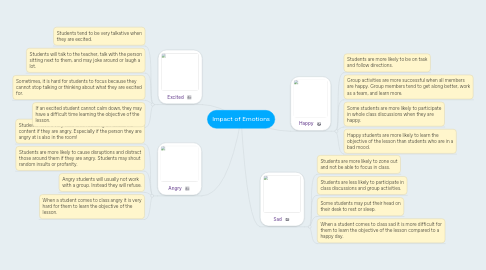
Impact of Emotions
por
Dana Patton
1. Angry
1.1. Students have a very hard time focusing on academic content if they are angry. Especially if the person they are angry at is also in the room!
1.2. Students are more likely to cause disruptions and distract those around them if they are angry. Students may shout random insults or profanity.
1.3. Angry students will usually not work with a group. Instead they will refuse.
1.4. When a student comes to class angry it is very hard for them to learn the objective of the lesson.
2. Excited
2.1. Students tend to be very talkative when they are excited.
2.2. Students will talk to the teacher, talk with the person sitting next to them, and may joke around or laugh a lot.
2.3. Sometimes, it is hard for students to focus because they cannot stop talking or thinking about what they are excited for.
2.4. If an excited student cannot calm down, they may have a difficult time learning the objective of the lesson.
3. Happy
3.1. Students are more likely to be on task and follow directions.
3.2. Group activities are more successful when all members are happy. Group members tend to get along better, work as a team, and learn more.
3.3. Some students are more likely to participate in whole class discussions when they are happy.
3.4. Happy students are more likely to learn the objective of the lesson than students who are in a bad mood.
4. Sad
4.1. Students are more likely to zone out and not be able to focus in class.
4.2. Students are less likely to participate in class discussions and group activities.
4.3. Some students may put their head on their desk to rest or sleep.
4.4. When a student comes to class sad it is more difficult for them to learn the objective of the lesson compared to a happy day.
Comienza Ya. ¡Es Gratis!
Conéctate con Google
ó
Regístrate