

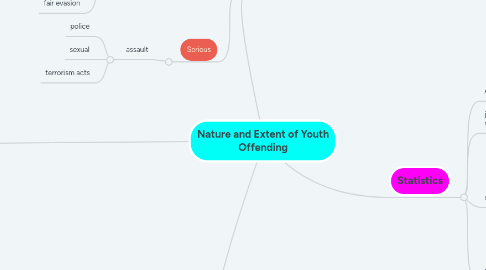
1. Offences
1.1. Minor
1.1.1. property
1.1.1.1. theft
1.1.1.2. vandalism
1.1.2. petty crime
1.1.2.1. shoplifting
1.1.2.2. domestic violence
1.1.2.3. unlicensed driving
1.1.2.4. fair evasion
1.2. Serious
1.2.1. assault
1.2.1.1. police
1.2.1.2. sexual
1.2.1.3. terrorism acts
2. Ecology
2.1. Microsystem
2.1.1. Immediate family
2.1.2. Identity
2.1.2.1. gender
2.1.2.2. ethnicity
2.1.2.3. sexuality
2.2. Mesosystem
2.2.1. Education system
2.2.1.1. school
2.2.2. household
2.2.3. childcare
2.2.4. extended family
2.3. Exosystem
2.3.1. media
2.3.1.1. news sources
2.3.1.2. social media
2.3.2. transport
2.3.2.1. public
2.3.2.2. personal
2.3.3. neighbourhood
2.3.3.1. social interactions
2.3.3.2. class
2.3.4. facilities & programs
2.3.4.1. youth groups
2.3.4.2. places of religion
2.3.4.3. parks
2.4. Macrosystem
2.4.1. politics
2.4.2. ideologies
2.4.2.1. beliefs
2.4.2.2. behaviours
3. Power
3.1. Capital
3.1.1. cultural capital
3.1.1.1. habitus
3.1.1.2. objectified
3.1.1.3. recognition
3.1.2. social capital
3.1.3. economic capital
4. Statistics
4.1. Age - crime curve
4.2. juveniles (10 to 17 year olds) comprise a minority of all offenders
4.3. state statistics on youth offending
4.3.1. VIC: 21% of offenders (08-09)
4.3.2. ACT: 16% of arrests (08-09)
4.3.3. NT: 8% of persons apprehended by the police (08-09)
4.3.4. WA: 13% offence counts (08-09)
4.3.5. QLD: 18% of offences (08-09)