


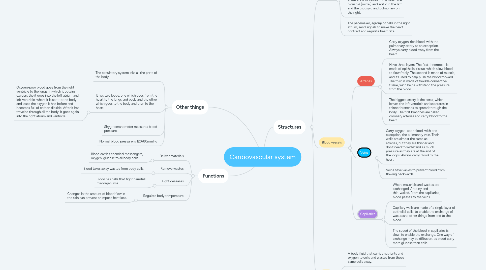
1. Functions
1.1. Deliver materials
1.1.1. Blood carries chemical messengers, oxygen, glucose to all body cells.
1.2. Remove wastes
1.2.1. Blood takes away wastes from body cells.
1.3. Fight deseases
1.3.1. Blood has cells that fight harmfull miroorganisms.
1.4. Regulate body temperature
1.4.1. Changes in the amount of blood flow in the skin can prevent or impose heat loss.
2. Other things
2.1. The circulatory system inks all the parts of the body.
2.2. It has two loops, one which goes from the heart to the lungs and back, and the other which goes to the body and then to the heart.
2.2.1. Oxygen-poor blood goes from the right ventricle to the lungs, in which it obtains oxygen, the it goes into the left atrium and left ventricle, where it is sent to the body and loses the oxygen it had before and becomes full of carbon dioxide. After it has traveled through all the body, it goes again into the right atrium and ventricle.
2.3. Shygmomanometer measures blood pressure.
2.4. Normal blood pressure is 120/80mmHg
3. Structures
3.1. Heart
3.1.1. It plumps blood to the body through blood vessels.
3.1.2. It has a dividing wall called the septum, which separates the left and right sides. Each side has two chambers, the atrium and the ventricle. The atrium reveives blood from the body and the ventricle pump it to the body.
3.1.3. There are four valves in the heart. the bicuspid (mitral) and aortic in the left and the tricuspid and pulmonary on the right.
3.1.4. The pacemaker, agroup of cells in the right atrium, send signals to make the heart contract and regulate heart rate.
3.2. Blood vessels
3.2.1. Arteries
3.2.1.1. Carry oxygen-rich blood, with the pulmonary artery as an exception. Always carry blood away from the heart.
3.2.1.2. Have three layers. The first, innermost, is made of epithelial tissue, which allow blood to flow freely. The second is made of muscle, and its used to help push the blood forward. The third is made of flexible connective tissue, wich helps withstand the pressure from the blood.
3.2.1.3. The biggest artery is the aorta, which leaves the left ventricle and separates in thinner branches to spread through the body. The first branches are called coronary arteries and carry blood to the heart.
3.2.2. Veins
3.2.2.1. Carry oxygen-poor blood, with one exception, the pulmonary vein. Their walls are almost the same as atreries, but they are thinner and don't need to withstand as much pressure as they are at the end of the loops. Always carry blood to the heart.
3.2.2.2. Veins have valves to prevent blood from flowing backwards.
3.2.3. Capillaries
3.2.3.1. Where materials and wastes are exchanged. Are tiny and thin-walled. From the capillaries, blood passes to the veins.
3.2.3.2. Capillary walls are made of a single layer of epithelial cells, to enable the exchange of wastesand other things from and to the blood.
3.2.3.3. The speed of the blood in capillaries is slow, to enable the exchange. One way of exchange may be diffusion, as blood carry more glucose than cells.
3.3. Blood
3.3.1. A body fluid that carries nutrients and oxygen to cells and wastes from those same cells away.
3.3.2. To move forward, many factors affect it. The volume of blood, the contractions of skeletal muscles, breathing movements and valves.
3.3.3. It has 3 solid components