

1. What is homeostasis?
1.1. Property of organisms to maintain a stable internal condition despite changing internal or external conditions
2. How do unicellular and multicellular organisms maintain homeostasis?
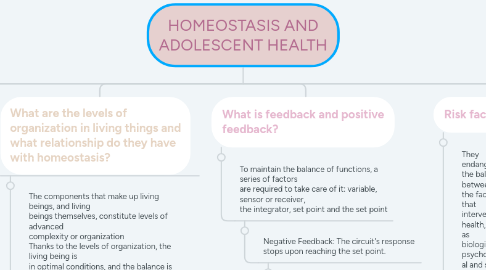
2.1. Each cell it deals with self-regulation, that is, maintaining its homeostasis, its life depends on this and multicellular organisms taking care of the balance of each and every one of their cells to survive
3. What are the levels of organization in living things and what relationship do they have with homeostasis?
3.1. The components that make up living beings, and living beings themselves, constitute levels of advanced complexity or organization Thanks to the levels of organization, the living being is in optimal conditions, and the balance is maintained through many regulatory mechanisms given by homeostasis.
3.1.1. -Atom -Biomolecules -Organelles -Cell -Tissue -Organs -Systems -Population -Community -Ecosystem -Biosphere
4. What is feedback and positive feedback?
4.1. To maintain the balance of functions, a series of factors are required to take care of it: variable, sensor or receiver, the integrator, set point and the set point
4.1.1. Negative Feedback: The circuit's response stops upon reaching the set point.
4.1.1.1. Positive feedback: The response is increased
5. Risk factors in adolescence
5.1. They endanger the balance between the factors that intervene in health, such as biological, psychologic al and social processes
5.1.1. BEHAVIORAL. Actions that the subject chooses to perform
5.1.2. PHYSIOLOGICAL. They involve the body and biology of a person and are related to genetic factors.
5.1.3. DEMOGRAPHIC. They relate to the general population
5.1.4. ENVIRONMENTAL. They include social, economic, cultural, political, physical, chemical and biological issues.
5.1.5. GENETIC. They are based on the genetics of the individual
5.1.6. RELATED TO EATING BEHAVIOR. Acceptance of society's attitudes about thinness, being a perfectionist, being a woman, anxiety, concerns about weight, body shape, among others.