


1. Fictional
1.1. Fantasy - a story in a fantasy world (ex. Shadow and Bone by Leigh Bardugo)
1.2. Folklore - old cultural stories (includes fairytales, fables, legends, and tall tales), (ex.The Exploits of Hercules)
1.3. Historical fiction - a fiction story based on real history (ex. A. Tolstoy's historical novel "Peter the Great")
1.4. Mystery - a story about a crime (ex. The Strange Story of Dr. Jekyll and Mr. Hyde by R.L.Stevenson
1.5. Realistic fiction - a story that seems real but isn't real (ex. Jane Eyre by Charlotte Bronte)
1.6. Romance - a love story (ex.Scarlet Sails by Alexander Grin)
1.7. Science fiction - a story in the future with advanced technology (ex. movie "Back to the Future" by Robert Zemeckis
1.8. Thriller or suspense - a story that makes readers nervous or excited (ex. The Call of Cthulhu by Howard Phillips Lovecraft)
2. Fiction - a story that did not actually happen in real life
3. Non-fiction - writing that real and factual, or that acrually happened
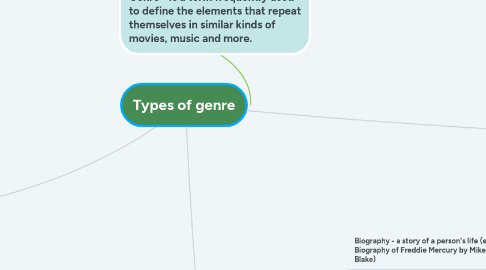
4. Genre - is a term frequently used to define the elements that repeat themselves in similar kinds of movies, music and more.
5. Non-fictional
5.1. Biography - a story of a person's life (ex. Biography of Freddie Mercury by Mike Blake)
5.2. Autobiography - a story the author writes about himself or herself (ex. The autobiography by Benjamin Franklin)
5.3. Reference materials - books with facts in alphabetical order (dictionary, thesaurus, and encyclopedia) (ex.Ozhegov 's Dictionary)
5.4. Periodicals - magazines, newspapers, and journals that are written regularly (ex.Izvestia newspaper)
5.5. Narrative non-fiction - a story (or narrative) that happened in real life
5.6. Memoir - an account written by somebody, especially somebody famous, about their life and experiences
5.7. Essay: typically illustrates the thoughts of an author on a specific issue, event, or philosophy
5.8. Article - a piece of writing about a particular subject in a newspaper or magazine, on a website, etc.
5.9. Instruction manual - is a document that communicates scientific, engineering, or other technical information to assist people using any goods, computer hardware, or software
5.10. Diary - a book in which you can write down the experiences you have each day, your private thoughts, etc.
5.11. The news: which is the announcing of daily incidents or updates within government, culture, industry, etc.
6. Aristotle's classification
6.1. Prose - a form of literature that follows a normal progression of conversation and syntax
6.1.1. The news: which is the announcing of daily incidents or updates within government, culture, industry, etc.
6.1.2. Biographies: tell the story of someone's life
6.1.3. Anecdote: used to teach lesson or illustrate a point
6.1.4. Essay: typically illustrates the thoughts of an author on a specific issue, event, or philosophy
6.1.5. Oration: this is basically a speech, and caters to the intellect, emotions, and will of the audience
6.1.6. Novel: is generally long and narrative; it tells a story with characters, a plot, and sa setting
6.1.7. Short story: a shorter narrative story with characters, a plot, and a setting
6.1.8. Fabels: a story that is passed down; it's purpose is to teach a lesson. A fable is about animals, plants or forces of nature that can talk and act like humans.
6.1.9. Legends: are about real life people and what they did. Legends always have an important purpose, but the facts are always a little exaggerated to make them more interesting and exiting.
6.1.10. Plays: tell a story with scripted dialogue, but are meant to be performed on a stage with actors, vocalists, props, etc.
6.1.11. Story - a description of events and people that the writer or speaker has invented in order to entertain people; the series of events in a book, film, play, etc.
6.2. Poetry - writing using language and sounds and special ways to express ideas (or a literary piece which uses rhyme, rhythm, and other styles in order to convey, strongly, a feeling or idea
6.2.1. Lyric - a poem about the speakers's thoughts (here can be included elegy, ode, and sonnet, and haiku) (ex.Ode on the day of the accession to the All -Russian throne of Her Majesty Empress Elisaveta Petrovna in 1747 by Lomonosov)
6.2.2. Narrative - a poem that tells a story ( includes epic (ex. Beowulf)
6.2.3. Dramatic - words spoken by a character (includes soliloquy, dialogue, and monologue)
6.3. Drama - a play for theatre told by character dialogue (talking)
6.3.1. Comedy - a funny, or humorous, drama with a happy ending (ex. The Comedy of Erroes by Shakeaseare)
6.3.2. Tradegy - a sad drama with a sad ending (ex. Romeo and Juliet by Shakespeare)
6.3.3. Farce: is written with the intent to be acted out on a stage or in film; is meant to engage th audience with embellished, exaggerated, and wildly unlikely situations.
6.3.4. Melodrama: is specifically written to attack the emotions; places a heavy focus on the plot rather than the characters themselves. (ex. films "Love and doves", "Titanic", etc.)