


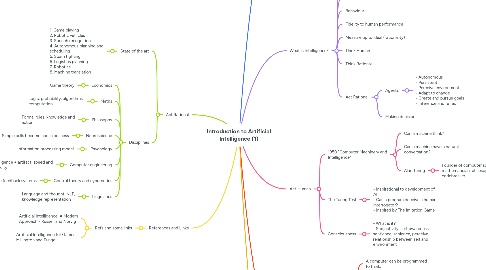
1. Act Rational
1.1. State of the art
1.1.1. 1. Game playing 2. Robotic vehicles 3. Speech recognition 4. Autonomous planning and scheduling 5. Spam fighting 6. Logistics planning 7. Robotics 8. Machine translation
1.2. Disciplines
1.2.1. Economics
1.2.1.1. Game theory
1.2.2. Maths
1.2.2.1. Logic, probability, algorithms, computation
1.2.3. Philosophy
1.2.3.1. Formal rules, knowledge and action
1.2.4. Neuroscience
1.2.4.1. Simple cells become consciousness
1.2.5. Psychology
1.2.5.1. Information processing model
1.2.6. Computer engineering
1.2.6.1. Intelligence + artifact, speed and capacity
1.2.7. Control theory and cybernetics
1.2.7.1. Stable feedback systems
1.2.8. Linguistics
1.2.8.1. Language and thought, NLP, knowledge representation
2. References and Links
2.1. Refs and some links
2.1.1. Artificial Intelligence: A Modern Approach - Russell and Norvig
2.1.2. Artificial Intelligence for Games - Millington and Funge
3. What is Artificial Intelligence?
3.1. - Goal: build intelligent entities - Thought processes and reasoning - Behaviour - Fidelity to human performance - Measure up to ideal (rationality)
3.2. Act Human
3.2.1. - NLP - Knowledge representation - Automated reasoning - Machine learning - Computer vision (perception) - Robotics (manipulation, manifestation)
3.3. Think Human
3.3.1. Study underlying principles, not try to duplicate
3.4. Think Rational
3.4.1. LOGIC
3.5. Act Rational
3.5.1. Agents
3.5.1.1. - Autonomous - Persistent - Perceive environment - Adapt to change - Create and pursue goals - Inference and reflex
3.5.2. Making decisions
4. What is Intelligence?
4.1. Goal: build intelligent entities
4.2. Thought processes and reasoning
4.3. Behaviour
4.4. Fidelity to human performance
4.5. Measure up to ideal (rationality)
4.6. Think Human
4.7. Think Rational
4.8. Act Rational
4.8.1. Agents
4.8.1.1. - Autonomous - Persistent - Perceive environment - Adapt to change - Create and pursue goals - Inference and reflex
4.8.2. Making decisions
5. Act Human
5.1. 1950 "Computer Machinery and Intelligence"
5.1.1. Can a machine think?
5.1.2. Can a machine have a natural conversation?
5.1.3. Alan Turing
5.1.3.1. Founder of computer science, mathematician, philosopher, codebreaker
5.2. The Turing Test
5.2.1. - Inspirational to development of AI - Can a program deceive a human interrogator? - Inspired by The Imitation Game
5.3. Consciousness
5.3.1. - What is it? - Subjectivity, self-awareness, sentience, sapience, perceive relationship between self and environment
6. Think Human
6.1. Strong AI
6.1.1. A computer can be programmed to think.
6.1.2. Cognitive science
6.1.2.1. Introspection
6.1.2.2. Psychological experiments
6.1.2.3. Brain imaging
6.1.3. Information processing model of the brain
6.2. Counter-argument
6.2.1. But it's a simulation - not consciousness.
6.2.2. 1980 John Searle
6.2.2.1. Mindless manipulators of symbols
6.2.2.2. Syntax not equivalent to semantics!
6.3. The Chinese Room
6.3.1. Chinese speakers send messages to someone in a closed room.
6.3.2. They get intelligent and well-written responses in Chinese.
6.3.3. But person in the room does not speak Chinese and is using a huge manual to find appropriate replies to the messages...
7. Think Rational
7.1. LOGIC
7.1.1. Started with Aristotle