

Income tax: rates and liability (2023-24)
Julia Bowyerにより
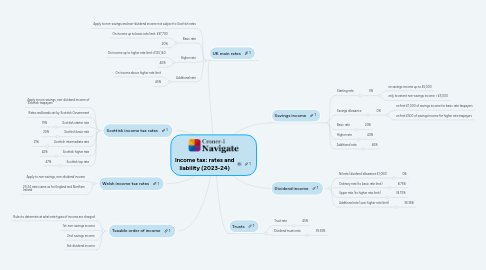
1. UK main rates
1.1. Apply to non-savings and non-dividend income not subject to Scottish rates
1.2. Basic rate
1.2.1. On income up to basic rate limit: £37,700
1.2.2. 20%
1.3. Higher rate
1.3.1. On income up to higher rate limit: £125,140
1.3.2. 40%
1.4. Additional rate
1.4.1. On income above higher rate limit
1.4.2. 45%
2. Scottish income tax rates
2.1. Apply to non-savings, non-dividend income of 'Scottish taxpayers'
2.2. Rates and bands set by Scottish Government
2.3. Scottish starter rate
2.3.1. 19%
2.4. Scottish basic rate
2.4.1. 20%
2.5. Scottish intermediate rate
2.5.1. 21%
2.6. Scottish higher rate
2.6.1. 42%
2.7. Scottish top rate
2.7.1. 47%
3. Taxable order of income
3.1. Rules to determine at what rate types of income are charged
3.2. 1st: non-savings income
3.3. 2nd: savings income
3.4. 3rd: dividend income
4. Welsh income tax rates
4.1. Apply to non-savings, non-dividend income
4.2. 23-24 rates same as for England and Northern Ireland
5. Savings income
5.1. Starting rate
5.1.1. 0%
5.1.1.1. on savings income up to £5,000
5.1.1.2. only to extent non-savings income < £5,000
5.2. Savings allowance
5.2.1. 0%
5.2.1.1. on first £1,000 of savings income for basic rate taxpayers
5.2.1.2. on first £500 of savings income for higher rate taxpayers
5.3. Basic rate
5.3.1. 20%
5.4. Higher rate
5.4.1. 40%
5.5. Additional rate
5.5.1. 45%
6. Dividend income
6.1. Nil rate (dividend allowance £1,000)
6.1.1. 0%
6.2. Ordinary rate (to basic rate limit)
6.2.1. 8.75%
6.3. Upper rate (to higher rate limit)
6.3.1. 33.75%
6.4. Additional rate (over higher rate limit)
6.4.1. 39.35%
7. Trusts
7.1. Trust rate
7.1.1. 45%
7.2. Dividend trusts rate
7.2.1. 39.35%