


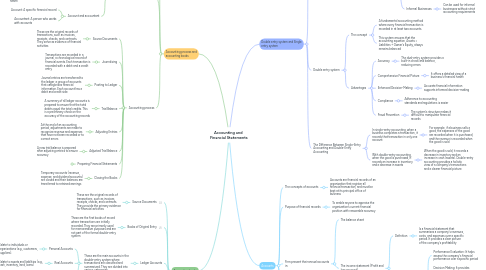
1. Accounting process and accounting books
1.1. What is accounting ?
1.1.1. Is a systematic process that involves identifying, measuring, recording, classifying, summarizing, analyzing, interpreting, and communicating financial information about an economic entity
1.1.2. Essentially, it's the language of business, providing insights into the financial health and performance of an organization
1.2. Distinguishing confused concepts
1.2.1. Accounting and accounting information
1.2.1.1. Accounting is the process of creating and analyzing financial information
1.2.1.2. Accounting information is the result of that process, providing insights into a business's financial health
1.2.2. Account and accountant
1.2.2.1. Account: A specific financial record
1.2.2.2. Accountant: A person who works with accounts
1.3. Accounting process
1.3.1. Source Documents
1.3.1.1. These are the original records of transactions, such as invoices, receipts, checks, and contracts. They serve as evidence of financial activities
1.3.2. Journalizing
1.3.2.1. Transactions are recorded in a journal, a chronological record of financial events. Each transaction is recorded with a debit and a credit entry
1.3.3. Posting to Ledger
1.3.3.1. Journal entries are transferred to the ledger, a group of accounts that categorizes financial information. Each account has a debit and credit side
1.3.4. Trial Balance
1.3.4.1. A summary of all ledger accounts is prepared to ensure that the total debits equal the total credits. This is a preliminary check on the accuracy of the accounting records
1.3.5. Adjusting Entries
1.3.5.1. At the end of an accounting period, adjustments are made to recognize revenue and expenses that have not been recorded or to correct errors
1.3.6. Adjusted Trial Balance
1.3.6.1. A new trial balance is prepared after adjusting entries to ensure accuracy
1.3.7. Preparing Financial Statements
1.3.7.1. Income Statement
1.3.7.1.1. Shows the profitability of the business over a specific period
1.3.7.2. Balance Sheet
1.3.7.2.1. Provides a snapshot of the business's financial position at a specific point in time
1.3.7.3. Cash Flow Statement
1.3.7.3.1. Shows the inflows and outflows of cash during a specific period
1.3.8. Closing the Books
1.3.8.1. Temporary accounts (revenue, expense, and dividend accounts) are closed and their balances are transferred to retained earnings
2. Accounting books
2.1. Source Documents
2.1.1. These are the original records of transactions, such as invoices, receipts, checks, and contracts. They provide the primary evidence for financial activities
2.2. Books of Original Entry
2.2.1. These are the first books of record where transactions are initially recorded. They are primarily used for memorandum purposes and are not part of the formal double-entry system
2.3. Ledger Accounts
2.3.1. These are the main accounts in the double-entry system where transactions are classified and summarized. They are divided into various categories:
2.3.1.1. Personal Accounts
2.3.1.1.1. Relate to individuals or organizations (e.g., customers, suppliers).
2.3.1.2. Real Accounts
2.3.1.2.1. Relate to assets and liabilities (e.g., cash, inventory, land, loans)
2.3.1.3. Nominal Accounts
2.3.1.3.1. Relate to income, expenses, and losses (e.g., sales revenue, salaries expense)
2.4. Trial Balance
2.4.1. A summary of all ledger accounts, ensuring that the total debits equal the total credits. It's a preliminary check before preparing the final accounts
2.5. Final Accounts
2.5.1. The final output of the accounting process, consisting of
2.5.1.1. Income Statement
2.5.1.1.1. Shows the profitability of a business over a specific period
2.5.1.2. Balance Sheet
2.5.1.2.1. Provides a snapshot of a business's financial position at a specific point in time
2.5.1.3. Cash Flow Statement
2.5.1.3.1. Tracks the inflow and outflow of cash
3. Double entry system and Single entry system
3.1. Single entry system
3.1.1. The concept
3.1.1.1. Is a method of bookkeeping that records only once each transaction, affecting a single account. It includes only cash records and personal accounts
3.1.2. Advantages
3.1.2.1. Simplicity
3.1.2.1.1. Easy to understand and implement
3.1.2.2. Cost-effective
3.1.2.2.1. Requires minimal bookkeeping effort
3.1.2.3. Quick Profit Calculation
3.1.2.3.1. Profit can be calculated directly from the cash book
3.1.3. When to Use a Single Entry System
3.1.3.1. Small Businesses
3.1.3.1.1. Suitable for businesses with simple transactions and minimal record-keeping needs
3.1.3.2. Cash-Based Businesses
3.1.3.2.1. Works well for businesses that primarily deal in cash transactions
3.1.3.3. Informal Businesses
3.1.3.3.1. Can be used for informal businesses without strict accounting requirements
3.2. Double entry system
3.2.1. The concept
3.2.1.1. A fundamental accounting method where every financial transaction is recorded in at least two accounts.
3.2.1.2. This system ensures that the accounting equation, Assets = Liabilities + Owner's Equity, always remains balanced
3.2.2. Advantages
3.2.2.1. Accuracy
3.2.2.1.1. The dual-entry system provides a built-in check and balance, reducing errors
3.2.2.2. Comprehensive Financial Picture
3.2.2.2.1. It offers a detailed view of a business's financial health
3.2.2.3. Enhanced Decision-Making
3.2.2.3.1. Accurate financial information supports informed decision-making
3.2.2.4. Compliance
3.2.2.4.1. Adherence to accounting standards and regulations is easier
3.2.2.5. Fraud Prevention
3.2.2.5.1. The system's structure makes it difficult to manipulate financial records
3.3. The Difference Between Single-Entry Accounting and Double-Entry Accounting
3.3.1. In single-entry accounting, when a business completes a transaction, it records that transaction in only one account
3.3.1.1. For example, if a business sells a good, the expenses of the good are recorded when it is purchased, and the revenue is recorded when the good is sold
3.3.2. With double-entry accounting, when the good is purchased, it records an increase in inventory and a decrease in assets
3.3.2.1. When the good is sold, it records a decrease in inventory and an increase in cash (assets). Double-entry accounting provides a holistic view of a company’s transactions and a clearer financial picture
4. Accounts
4.1. The concepts of accounts
4.1.1. Accounts are financial records of an organization that register all financial transaction, and must be kept at its principal office of business
4.2. Purpose of financial records
4.2.1. To enable anyone to appraise the organization’s current financial position with reasonable accuracy
4.3. Firm present their annual accounts in:
4.3.1. The balance sheet
4.3.2. The income statement (Profit and loss account)
4.3.2.1. Definition
4.3.2.1.1. Is a financial statement that summarizes a company's revenues, costs, and expenses over a specific period. It provides a clear picture of the company's profitability
4.3.2.2. The important of P&L
4.3.2.2.1. Performance Evaluation: It helps assess the company's financial performance over a specific period
4.3.2.2.2. Decision Making: It provides valuable insights for making informed business decisions
4.3.2.2.3. Investor Analysis: It's a key tool for investors to evaluate a company's financial health and potential
4.3.2.2.4. Tax Planning: It helps identify tax implications and optimize tax strategies