
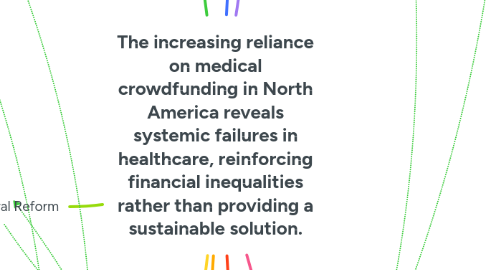
The increasing reliance on medical crowdfunding in North America reveals systemic failures in hea...


1. Privilege in Crowdfunding Success
1.1. lying to get donations
1.2. creative narrtives
1.3. access to social media
1.3.1. Kubheka (2020) Kubheka’s analysis raises critical ethical concerns about equity in healthcare access, as those with greater social media reach or compelling narratives may secure more funding. In contrast, others in similar medical and financial distress may struggle.
1.3.1.1. Emotionally appeal-ing pictures, digital marketing skills, and frequent up-dates are some of the factors influencing the success ofKubheka BMC Medical Ethics (2020) 21:96 Page 2 of 5 campaigns [1, 2]. Evidently, successful campaigns areseen in patients or caregivers with extensive pre-existingnetworks of people; donors tend to be from the samesocio-economic class.
1.3.2. Mr. Beast (2025) “If insurance doesn’t cover that, what do you do?”—suggesting that without private philanthropy or crowdfunding, these individuals might never have received treatment.
1.3.3. Young (2017) The ability to secure funding may depend not only on medical need but also on a patient's storytelling ability, social network reach, and the emotional appeal of their case.
1.3.4. Kenworthy (2022) The study underscores how crowdfunding has become a crucial mechanism for individuals facing gaps in healthcare coverage and social safety nets. It highlights the limitations of relying on such platforms, noting that many campaigns failed to reach their fundraising goals, thereby leaving individuals without the financial support they needed.
1.3.4.1. The analysis also reveals disparities in the success of crowdfunding campaigns based on race, with campaigns involving people of color receiving fewer donations, highlighting the inequities in access to resources. This adds to the ongoing conversation about the role of crowdfunding in perpetuating social and economic disparities, as noted in other studies.
1.4. age of recipient
1.5. type of medical need
1.6. location of recipient
2. Structural Reform
2.1. create legislature to lower cost
2.2. provide more doctors
2.3. build more hospitals
2.4. cover rural areas
2.5. provide access to specialists
3. social media
3.1. GofundMe
3.2. X
3.3. Facebook
3.4. instagram
3.4.1. Kenworthy (2022) Using a mixed-methods analysis of 919 randomly selected GoFundMe campaigns, the authors find that most campaigns were unsuccessful, with 38% receiving no donations.
3.4.2. Kubheka (2020) Crowdfunding websites offer an option to share campaigns on social media platforms like Facebook, therefore, giving individuals with existing extensive social networks access to a broader audience of potential donors. People who are well connected are more likely to have successful campaigns, thus perpetuating inequality. In this way, donor decision-making is vulnerable to influence from social value instead of medical need [9] perpetuating unintended discrimination. More so in countries with significant socio-economic inequality, typically accentuated by a digital divide, further propagating injustices.
3.5. indiegogo
3.6. kickstarter
4. North America
4.1. Canada
4.2. United States
5. Healthcare Gaps
5.1. Types of gaps
5.1.1. longer wait times
5.1.2. lack of coverage for dental care
5.1.3. l.a.c. pharmaceuticals
5.1.3.1. In Snyder (2020), the author highlights significant gaps in Canada’s publicly funded healthcare system, emphasizing that services such as prescription drugs, eye care, and dental care are not covered under the Canada Health Act. As a result, access to these essential health services is contingent upon an individual’s income, employment status, and geographic location, with some support provided through social programs or private insurance.
5.1.3.2. Kubheka (2020) These include gaps in insurance coverage, inadequate public health funding, and systemic failures that create barriers to care.
5.1.4. difficult access to specialists
5.1.5. inadequate coverage i.e. higher costs
6. Inequality & charitable giving
6.1. crowdfunding & distribution
6.1.1. succesful campaigns
6.1.2. greater social media reach
6.1.2.1. Kenworth (2022) The analysis also reveals disparities in the success of crowdfunding campaigns based on race, with campaigns involving people of color receiving fewer donations, highlighting the inequities in access to resources. This adds to the ongoing conversation about the role of crowdfunding in perpetuating social and economic disparities, as noted in other studies.
6.1.2.1.1. Using a mixed-methods analysis of 919 randomly selected GoFundMe campaigns, the authors find that most campaigns were unsuccessful, with 38% receiving no donations.
6.1.2.2. Young and Scheinberg (2017) crowdfunding sites utilize sophisticated search tools that allow donors to filter campaigns based on disease, age, location, or personal background, enabling targeted giving.
6.1.2.2.1. This discussion underscores the dual nature of medical crowdfunding: while it offers an immediate financial lifeline for those in need, it also raises ethical concerns about fairness and access.
6.1.2.2.2. The ability to secure funding may depend not only on medical need but also on a patient's storytelling ability, social network reach, and the emotional appeal of their case.
6.1.2.3. Kubheka (2020) Kubheka’s analysis raises critical ethical concerns about equity in healthcare access, as those with greater social media reach or compelling narratives may secure more funding.
6.1.3. compelling narratives
6.1.4. financial distress
7. Policy & Reform Proposals
7.1. increase coverage
7.2. lower costs
7.3. provide alternatives
7.3.1. Snyder (2020) We encourage the development of new resources to harness the power of crowdfunding data as a supplementary source of information for Canadian health system stakeholders.
7.3.2. Sisler (2012) The article suggests that, rather than depending on crowdfunding, systemic reforms are needed to ensure more equitable and sustainable healthcare access.
7.3.3. Kenworthy (2022) Kenworthy et al. conclude that while crowdfunding provides immediate relief for some, it is not a sustainable or equitable solution to the broader issues of healthcare access and financial instability. They call for systemic reforms to address the root causes of these challenges, emphasizing that crowdfunding should not replace structural changes in social and healthcare policies. This study reinforces the idea that crowdfunding, though valuable in urgent situations, cannot address the fundamental inequities in healthcare systems and social safety nets.
7.4. lower wait times
7.5. provide affordable healthcare options
8. Systemic Failures
8.1. insurance gaps
8.2. inadequate public healthcare funding
8.2.1. In Snyder (2020), the author highlights significant gaps in Canada’s publicly funded healthcare system, emphasizing that services such as prescription drugs, eye care, and dental care are not covered under the Canada Health Act. As a result, access to these essential health services is contingent upon an individual’s income, employment status, and geographic location, with some support provided through social programs or private insurance.
8.2.1.1. This citation reinforces a broader critique of medical crowdfunding found in Snyder’s earlier work (2016) and other studies, such as Kenworthy et al. (2022), by illustrating how even countries with universal healthcare systems still leave individuals vulnerable to financial barriers in accessing necessary medical care. The mention of coverage gaps also aligns with Kubheka (2020), who discusses the ethical concerns of relying on alternative funding mechanisms like crowdfunding or charity when public healthcare systems fail to meet all medical needs.
8.2.2. Kubheka (2020) These include gaps in insurance coverage, inadequate public health funding, and systemic failures that create barriers to care.
8.2.2.1. Notably, some patients resort to crowdfunding for direct health care expenses because of shortfalls in medical insurance cover; inadequate public health funding and desperation caused by financial strain from life-threatening medical conditions [ [2, 6]].The drive for crowdfunding may be compounded by system failures resulting in barriers to accessing care and limited availability of services, to name a few.