


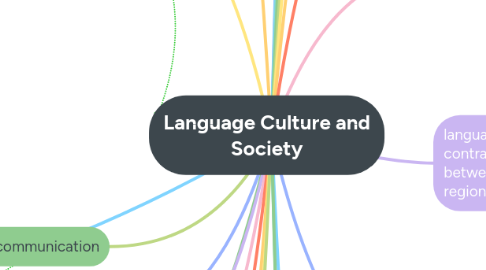
1. aquiring nd usinfg languages
1.1. children learn by hearing languagae by age 1 can say a few word such as momma dada, by 2 two words and so on as they continue but understanda alot more words by age 5 ask questions , male negative statements prodece complex snrtences. all this without formal teaching.
1.2. behaviroal pschology theory is based on the stilmulus response reward formula and is not unlike the popular view od language aquisition . the human environment provides languages stimuli to which the child responds largely by repitition of what he or she is hearing
1.3. bilinguilism some people learn two languagess natively , native in one and lear the other later. passive - having ability to just ubderstand other language but not speak
1.4. code switching- when a bilingual introduces a word from a different language to its speech. Disglossia is use of two distinct varieties of a language for two different sets of functions.
2. The develoopmeny and Evolution of Language: Languge Birth , Language growth and Language Death
2.1. ape experiments
2.1.1. in the wild besides visual and other signals, apes use a variety if vocal sounds , including grunts, pants, barks, whimpers , screams, squees and hoots,
2.1.1.1. fist expereimnt to teach apes to speak was begun with Keith J. Hayes and Catherine Hayes in 1940 after many years concluded to only 4 word learned by adopted chimpazene and main form of coominication was thoush postures, facial expression and gestures.
2.1.1.2. recents experriemtn of an infants chimpazene, Washoe was taugth the form of gestural language used by American deaf. Washoe learned more than 30 signs spontaneeuosly and understood more that twice that many , and could use combination of several signs. after 5 years she wasprofivient in 150 hnd signs
2.1.1.3. another exeperiment with sarah was taught ot read and write by the means of plastic tokens of various shapes, sizes and colors wach token representing a word.
2.1.1.4. in conclusion after many experiments and advancemt chimpa re still limited in what it can sign compared to a human child of six, they ar mostly profiecitn in use of repertory of gestural signs.
2.2. Phasedesign features of language in 1960s charles hocket and other proposed a set of design features of language (properties that characterize human speech
2.2.1. 1.vocal auditory channel-some sounds produced by animals are not vocal 2. broadcast trabsmission 3. rapid fading. 4interchagibility. 5 complete feedback. 6. specailization. 7. semancity 8. arbotrariness. 9. discreetness 10. displacement 11. productivity 12. diality of patterning 13. cultural transmission
2.2.1.1. human language posseses these while aother animals only posses some
3. nonverbal communication
3.1. Includes bodily gesture, facial expressions, spacing, touch, and smell
4. kinesics the sutudy of body language
5. 1.voval auditory channel
5.1. design features of language in 1960s charles hocket and other proposed a set of design features of
6. new expriment sof pygmy chimpazened have proven they are smarter than other chimps and enhoy human contact and are less agressive. , E.S savage did a study a 12 yeard old female and her adopted son showing how they interacted. the son would comminate when he needed assistance and pointed to objects with vocal signals and visual checking. and lead teachers by hand . just apeeared to bettter comprehent socail situations and more simillar to of human behvior
7. Early Linguistic Anthroplologist
7.1. Franz Boaz
7.1.1. Edward Sapir
8. Linguistic Annthropology Background
8.1. The study of universal phenomenom of human language. "The hollistic study of humankind"
8.1.1. why study it?"Language is involved in a variety of human situtations perhaps every situation. The scientific study of language is one of the keys to understanding much of human behavior." ( Stanlaw et.al, 2)
8.1.1.1. Linguistic does refer to the study of a particular language for the purpose of learning to speak it; rather , it refers to the analytical study of language, any language to reveal its structure." (Stanlaw et.al, 10)
8.2. Myths
8.2.1. monolingual, phonetics,learning another language, stupid dialects. fluency
8.3. Began with the exposure of European immigrants to Native Americans
9. Linguistics vs. Linguistic Anthropology
9.1. linguistic - primarily in language structure
9.2. linguistic anthropology- focuses on social cultures, speakers, and language use.
9.2.1. Two major paradigms: Classic structural & Noam Chomsky's generative grammar
10. Nuts and Bolts: Language is a Sound
10.1. phonology- sound structure of language
10.1.1. The sounds of each language differ from one another; a word can sound the same and have diferent meanings. ex lead pipes lead
10.2. Anatomy and Philosophy of Speech
10.2.1. "Speakers use mother tongue aumatically, production of sound requires well coordinated and precise movement and pisitioning of various parts of speech apparatus located between the diaphragm and the lips." ( Stanlaw et. al 40)
10.3. Phone is smallest segment of speech
10.4. Articulation of Speech Sounds vowels: "A, E, I, O, U, sometimes Y"
10.4.1. Vowels are classified depending on the part of the tongue that is raised and movement of lips.
10.5. Consonants- "Sound is altered or modified greatly as it passes through the mouth and throat" ( Stanlae et. al 45)
11. Structure of word and sentences
11.1. every language has its own set of morphenes( smallest meaningful segment.)
11.2. free vs bound
11.2.1. prefix, suffix, infix
12. Transmission of signals accomplished by means other than spoken words
13. haptic behavior
14. proxemics - " The study of the cultutal patterning of the spatial seperation individuals maintain in face to face encounters" ( Stanlaw et.al 92)
15. "Although spoken laguage is the most efficient means of humman communication thereare many other ways in which people transmit, or exchange information." (Stanlaw et. al 112)
16. ethonography of communication
16.1. the nature iand cd function og commmunictive behavior int the context of culture are the subject of it
16.2. units of speech behavior : speech sitiuation, speech, event, soeech act
16.3. components of communocaton : participants, setting.,
16.4. purpose, channer message content and forms.
16.5. keys, roles of interaction, roles of interaction
17. language culture and thought
17.1. whrf principles of linguistic determinism( what one thinks is determined bylanguage one speaks/ linguistic relativity the difference among languages must therefore be reflected in the difference the world views of their speakers
17.1.1. color nomenclature lennerbers and roberts idea was to use an array of 320 scientifially calbirates color chips similar to what you woukdlsee in display at at store they defined " basic terms with certain criteria
17.1.1.1. theorital and philosophical counterarguments to linguistic relativity transibility, mutual linguistic comprehension , language abd though, multilingualsim, language change understanility, language and percetion , language unversal
18. race ethnicity and nationanality
18.1. speech differences can be categorized bey difference social and economc class
18.1.1. sociallinguistic change linguistic change understood in the context of the society it occurs
18.1.1.1. much of the differnce in language use we hear around us is a ressult from other causes
19. language though time - languages arre classified into families. they are descnedent from one single ancetrol language.
19.1. such as the indo erupean language family- consist of a dozen branches and there are language isolates that are not related to any other
19.2. the ten largest conventiona language families: Indo european, sino-tibetan. niger-congo, afro-asiatic, autronesian, dravidian, japanese, altaic, austroasiatic, korean
20. language typologies based on structural similarities of languages regardless of their history,regardless of genetic relationshios.
20.1. morphology ans semantic relationships
21. sound changes
21.1. assimilation- influence of sound on a neighborings sound so that the two become similar or the same.
21.2. dussimilation- one of two identical or very similar neighboring sounds of a word is changed or ommited because a speaker may find the repetition of the same articulatory movement difficutl in rapid speech .
21.3. methasis- the transportation of sounds or larger units.
22. changes in vocabulary
22.1. loanwords- languages adopt foreign words , english is very open to loanwords,
23. language variation and language in contrast- speech patttern change between individuals from different regions.
23.1. idiolect- an individuals speech variety = changes depending on social situtation.
23.2. people living in the same geographic ares speak similar idiolects compared to other groups
23.3. according to martin joos there are 5 styles of his dialect of american english (frozen, formal, consultative, casual, intimate)
24. language contact- as long as there have been human beings there is language contact leads to languages dying , new languages can develop, or languages in contact can become mixed.
25. Culture as Cognition
25.1. use of semantics preclude ex[lanations of figurative language, metaphorical use of words, or language change, but nothing on on synonyms, antonyms or homomyns. seamtics is influenced by different principles from modern computer scientist to classical scholars.
25.2. concepts word and categories- are often not distinguised and much of the literature ises terms interchangably. word is usuaally spoke snd is the representation concepts is the menta lglue that ties past experince our knowledge od some cateegory or clss of the object in the world with our present expereince in labeling them by means of words. categories are subltle. no two thind are the same.
25.3. categories are sets of referents that are grouped together. 5 points: our abiltiy to aplly our knowlede about the category that manes categorization useful 2)not a single referent 3) esssential aspect of cognition is the ability to categorize 4) without caegory , memory is useless 5) not all cateogorization is linguistic
25.4. new ethonography " ethoscience" focused on lexical classifications of the social and physical enviroments of speakers of a language by means of its vocabulary rather that the relationship of gramatiical catergories/ it was a motication to make anthopoly more scientific. .
25.5. folk taxanomy - fieldworkr tries to uncover how natives conceive of the structure of a particular domain. ex cars in the US in categorizing differnt cars as ford, chevrolet etc or in labeling differnt coffe drinks
25.6. componetial analysis- the focus is on the necessary and sufficient features that are used to distinguis all the terms in the domain. just goes into more differnt terms and categories
25.7. meaning in discorse and conversation- when people speak they have beliefs that bring up the conversation . pregmatic presupposition are assumtions that speakers make anout what their listeners willl accept without challenge.
25.8. conclusion- 1) tendacy for people to think in terms of linguistiv and sociocultural binary opposition 2) all languages and cultures classify at least certain aspects of the worls through labeled domains that are hierachial. 3) some direct nonarbitrary assocaiton between from and meaning found in all languages 4) all languages have rules that govern social discourse and conversation ,, include points of view and their presupossitioms. results lead to miscommuncation and sanctions.
26. language identity and ideology variation in gender
26.1. men and womne speak differenly women use tag qustion, hedges, and other diferences
26.1.1. differnce theory, subculture theory, dominace theory and power theory
26.1.1.1. communacative strategy the nahuatl women changed used less obvious features such as spanish phonlogy