


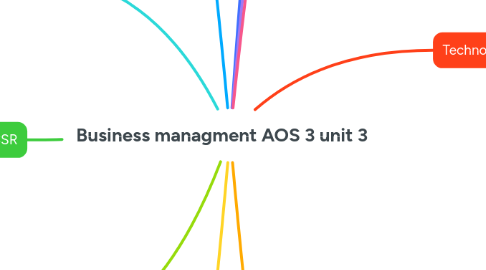
1. Quality
1.1. The level of excellence in a good or service
1.1.1. Quality Control
1.1.1.1. Involves a series of inspections at different structures of the transformation process to ensure that products meet standards
1.1.1.2. Advantages: Prevents poor quality, leading to good brand image. Employee performance improves as their work is being inspected, therefore motivating them.
1.1.1.3. Disadvanatges: Reactive process can be wasteful, as some bad quality products will be thrown out. Time- consuming, as quality control needs to be used on every product.
1.1.2. Quality assurance
1.1.2.1. A proactive process that aims to build quality into work processes to avoid errors in production.
1.1.2.2. Advantages: Great for marketing, gives competitive advantage as customers know it is a good product. Reduces wastage, as the process aims to reduce waste.
1.1.2.3. Disadvantage: Expensive. Time-consuming, as documents need to be made prior to the investegation.
1.1.3. Total quality managment
1.1.3.1. A holistic approch to quality where all employees are involved in the continuous pursuit of quality in everything to do. The aim is to have zero defects.
1.1.3.2. Key principles: Continuous improvement, customer focus, employee participation.
1.1.3.3. Advantages: Zero defects, as it uses a presentive approach that minimises waste. Employee participation, employees will know they are valued and therefore have more motivation. High customer satisfaction, as it is a high quality end product.
1.1.3.4. Disadvantages: Time consuming as employees have to take time away from other tasks to improve completed tasks. Requires a whole business cultural shift, as all employees need to contribute.
2. Waste managment
2.1. The act of reducing the amount of materials or goods discarded in the production process
2.1.1. Reduce
2.1.1.1. Creating less waste
2.1.2. Reuse
2.1.2.1. Finding a new purpose for old or unwanted items
2.1.3. Recycle
2.1.3.1. Changing discarded materials into a new product.
3. CSR
3.1. The businesses ability to go above and beyond what is legally required for the business, including stakeholders, societies, and the environment
3.1.1. Examples
3.1.1.1. Inputs: Using green energy options
3.1.1.2. Processes: Using waste managment
3.1.1.3. Outputs: Using recyable bags
4. Lean managment
4.1. A systematic process for improving product quality while reducing waste.
4.1.1. Key principles
4.1.1.1. Pull
4.1.1.1.1. When customer demand determines what is produced
4.1.1.2. Takt
4.1.1.2.1. The speed in which manufacturing needs to take place.
4.1.1.3. One peice flow
4.1.1.3.1. Focus on one peice/ product at a time.
4.1.1.4. Zero defects
4.1.1.4.1. Any mistakes are fixed before moving through production
5. Global considerations
5.1. Goods and services can be transported around the world easily
5.1.1. Global sourcing of inputs
5.1.1.1. Buying inputs from other countries
5.1.1.1.1. Strengths: Access to materials all over the world, meets customer needs. Able to specialise in production, increasing quality. Cheaper inputs avaliable, increasing profit.
5.1.1.1.2. Weaknesses: Long delivery times, putting a halt on production. Risk of damage during shipping, increasing waste. Expensive.
5.1.2. Overseas manufacturing
5.1.2.1. When a product is produced in another country.
5.1.2.1.1. Strengths: Works well with large volumes of simple manufacture when time does not matter, allows mass production. Access to new export markets, easy access for delivery to other countries. Can use overseas expertise to produce goods, improving quality
5.1.2.1.2. Weaknesses: Lost jobs in domestic manufaturing, leading to mass redundancy. Long delivery times, frustrating customers. Risk of damage in shipping, causing wastage.
5.1.3. Global outsourcing
5.1.3.1. Where a businesses operations is done by another business in a different country.
5.1.3.1.1. Strengths: Outsource tasks with less importance, focus on acheiving business objectives. Great for IT based services, access to complete tasks around the clock.
5.1.3.1.2. Weaknesses: Relies on the internet. Don not have full control of how products will de delivered, may have bad quality.
5.1.4. Supply change managment
5.1.4.1. The process of managing materials from suppliers through the operation system and to the end customer.
5.1.4.1.1. Strengths: Cheaper production. Business is not directly reponsible for factory production, more time to spend on business objectives. Good for large volumes of simple assembly.
5.1.4.1.2. Weaknesses: Complicated to manage, must consider quality and costs of supplies. Long delivery times, frustrated customers. Language barriors, causing delays in production.
6. Relationships between operations and objectives
6.1. Productivity
6.1.1. Ratio of outpouts reduced to the inputs required
6.2. Business competivness
6.2.1. A businesses ability to outperform its rivals
6.3. Effciency
6.3.1. How well the recources are used to create outputs
6.4. Effectiveness
6.4.1. How well a task has been completed
7. Elements of an operations system
7.1. Inputs
7.1.1. Recourses needed to produce a good/ service
7.2. Processes
7.2.1. transformal stage
7.3. Outputs
7.3.1. Final product
8. Characteristics of a manufacturing system
8.1. Manufacturing business
8.1.1. Undertakes activites to make a tangible good
8.2. Service Business
8.2.1. Undertakes activities to create an intangible good
9. Technology
9.1. Technological advancements
9.1.1. Disadvantages: Expensive. If system breaks down; production stops, negetivly impacts competivness effeiceny effectivness and brand image. Redquires technical training and can lead to redundancy
9.1.2. How advancements in machenery help improve effectivness and effciency
9.1.2.1. Automated production lines
9.1.2.1.1. A process where raw materials enter and and finished products come out with little to no human intervention
9.1.2.2. Computer aided design and manufacturing
9.1.2.2.1. Computer aided design: Computer programs that improve th creation and editing of the design; allows for creation of 3D designs
9.1.2.2.2. Computer aided manufacturing: A technique that involves the control of a machine and equipment through a computer to manufacture a good
9.1.2.3. Robotics
9.1.2.3.1. A highly specialised form of technology, able to do complex tasks
9.1.2.4. Online services
9.1.2.4.1. Platforms that allow a business to provide their services to customers through the internet
9.1.2.5. Artificial intelligence
9.1.2.5.1. Computers that have the ability to do tasks normally done by humans, using human intelligence.
9.1.3. Advantages: Productivity rates increase, improves effciency competivness effectivness and quality, less human labour, more accuracy
10. Materials
10.1. Materials managment
10.1.1. Managing the way materials are recieved and stored and ensuring that the correct amount and quality of inputs are avaliable when needed
10.1.1.1. Forcasting
10.1.1.1.1. Predicting what materials will be needed and in what quantities to meet operations neeeds. Usally done by analysing past data and trends
10.1.1.2. Just in time
10.1.1.2.1. When supplies arrive just as they are needed, being dispatched to the customer as soon as the product is ready. JIT avoids holding any stock.
10.1.1.3. Master production schedule
10.1.1.3.1. Breaks down the whole production process into stages and determines exactly what is required, what needs to be produced and when.
10.1.1.4. Materials requirement plan
10.1.1.4.1. An itemised list of all items required to meet the MPS