


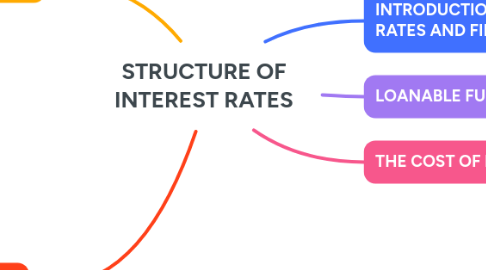
1. INTEREST RATE DETERMINATION
1.1. OVERVIEW
1.1.1. **Nominal or Quoted Interest Rate (r)** - the rate charged or earned on a debt security. Determined by aggregate supply and demand for loanable funds, risk, and structural factors.
1.1.2. **interest rates may differ** depending on characteristics
1.1.2.1. issuer type
1.1.2.2. time to maturity
1.1.2.3. risk
1.1.2.4. marketability
1.2. COMPONENTS OF NOMINAL INTEREST RATE
1.2.1. **r***- Real risk-free rate
1.2.1.1. Theoretical return on riskless short-term investment with no inflation
1.2.1.1.1. Influenced by
1.2.1.1.2. Ranges from 1% - 3%, varies with economic conditions
1.2.1.1.3. Often estimated using yields on short-term government securities
1.2.2. IP - Inflation premium
1.2.2.1. Compensates for the expected erosion of purchasing power due to inflation.
1.2.2.1.1. Based on **future expected inflation**, not historical
1.2.2.2. Directly increases the nominal interest rate
1.2.2.2.1. r_RF=r*+IP
1.2.3. DRP - Default risk premium
1.2.3.1. compensates for the possibility that the borrower might fail to pay interest or principal
1.2.3.1.1. Government bonds are considered default-free
1.2.3.1.2. **Corporate securities** carry default risk, determined through **credit ratings**
1.2.3.2. Higher credit rating = lower DRP = lower interest rate
1.2.3.2.1. Rating Agencies
1.2.3.3. **DRP = r (corporate) - r (gov't)**
1.2.4. LP - Liquidity Premium
1.2.4.1. compensates for the difficulty of converting an asset to cash quickly and at fair value
1.2.4.1.1. illiquid securities are harder to sell without price discount
1.2.4.1.2. not applicable to gov'r
1.2.4.1.3. charged on corporate securities that have **low trading volume** or are **not exchange-listed**
1.2.4.1.4. Investors prefer high-liquidity securities
1.2.5. MRP - Maturity risk premium
1.2.5.1. Reflects risks associated with the length of time to maturity
1.2.5.1.1. Long-term securities are more exposed to
1.2.5.1.2. Long-term securities have higher MRP than short-term
1.2.5.1.3. Both gov't and corporate bonds are subject to this
1.2.5.2. **MRP_t = 0.1% x (t-1)**, where t is time to maturity
1.3. TERM STRUCTURE OF INTEREST RATES AND YIELD CURVE
1.3.1. the relationship between the **interest rates (yields)** and the **maturity of debt securities** with similar risk profiles
1.3.1.1. YIELD CURVE TYPES
1.3.1.1.1. **Upward Sloping (Normal Curve)**
1.3.1.1.2. Downward Sloping (Inverted Curve)
1.3.1.1.3. Flat Curve
1.3.1.2. USES OF YIELD CURVE
1.3.1.2.1. **Investors**: choose between short vs. long-term investments
1.3.1.2.2. **Borrowers**: assess which term provides lower cost of capital
1.3.1.2.3. **Economists & Policy Makers** - gauge market expectations on interest rates and economic outlook
1.3.2. typically observed via **government securities** to exclude credit risk differences
2. THEORIES OF TERM STRUCTURE OF INTEREST RATES
2.1. EXPECTATION THEORY (PURE EXPECTATIONS THEORY)
2.1.1. Key Concepts
2.1.1.1. The long-term interest rate is determined solely by expectations of future short-term rates
2.1.1.2. **No maturity risk premium**
2.1.1.3. Investors are indifferent between holding a long-term bond or a series of short-term bonds if the returns are the same
2.1.2. Assumptions
2.1.2.1. investors make decisions based on their expectation of future interest rates
2.1.2.2. long-term securities are considered no riskier than short-term ones
2.1.2.3. no preference for maturity; long-trm and short-term bonds are perfect substitutes
2.2. LIQUIDITY PREFERENCE THEORY
2.2.1. Key Concept
2.2.1.1. Investors prefer short-term securities bcs they carry lower risk
2.2.1.2. they demand a liquidity premium to hold long-term securities
2.2.2. Assumptions
2.2.2.1. Longer-term bonds are riskier due to
2.2.2.1.1. Greater exposure to interest rate fluctuations
2.2.2.1.2. Uncertainty about long-term economic outlook
2.2.2.2. Investors need to be compensated for these risks through liquidity premiums
2.2.3. Implication
2.2.3.1. The long-term interest rate includes
2.2.3.1.1. Expected average of short-term interest rates
2.2.3.1.2. plus a liquidity premium that increases with maturity
2.2.3.2. **yield curve** will be upward-sloping, even if interest rates are not expected to rise, due to the added liquidity premium
2.2.4. Supporting Reasons
2.2.4.1. investors accept lower returns on short-term securities due to lower risk
2.2.4.2. short-term investments are more liquid and easily convertible to cash
2.2.4.3. borrowers prefer long-term loans to lock in rates and avoud refinancing risks
2.2.4.4. investors require higher returns for committing funds over longer periods
2.3. MARKET SEGMENTATION THEORY
2.3.1. Key Concepts
2.3.1.1. debt market segment by maturity; each segment operates independently based on its own supply and demand
2.3.2. Assumptions
2.3.2.1. Investors and borrowers have preferred maturity segments
2.3.2.2. They do not switch beteeen maturities unless compensated by an additional premium
2.3.2.3. Diff. maturity markets have diff. risk preferences and demand dynamics
2.3.3. Implication
2.3.3.1. shape of yield curve depends on the supply and demand balance in each segment, not on expectations
2.3.3.1.1. e.g. if there's high demand and low supply in short-term segment - lower short-term rates
2.3.3.1.2. e.g., low demand and high supply in long-term segment - higher long-term rates
2.3.3.2. **yield curve** reflects institutional preferences, not expectations or premiums
3. INTRODUCTION TO INTEREST RATES AND FINANCIAL MARKETS
3.1. ROLE OF FINANCIAL MARKET
3.1.1. Enables transfer of funds from savers to investors/borrowers
3.1.2. Providers expect returns
3.1.2.1. Equity Instruments: dividends
3.1.2.2. Debt Instruments: interest payments
3.2. NOMINAL INTEREST RATE
3.2.1. *Stated percentage earned or paid on financial securities *
3.2.1.1. Classification
3.2.1.1.1. Maturity Period
3.2.1.1.2. Tyoe of Financial Instrument
3.2.1.2. Purpose
3.2.1.2.1. Reflects the return expected by investors
3.2.1.2.2. Serves as a benchmark for
3.2.1.3. Affects
3.2.1.3.1. Prices of financial securities
3.2.1.3.2. Investment behavior
3.2.1.3.3. government and business economic decisions
3.2.1.3.4. overall economic performance and sector profitability
3.3. HISTORICAL TRENDS IN THE PHILIPPINES INTEREST RATES
3.3.1. **1998-2002:**
3.3.1.1. Downward trend
3.3.1.1.1. easing inflation
3.3.1.1.2. better fiscal management
3.3.2. **2004-2008**
3.3.2.1. Gradual increase
3.3.2.1.1. local political uncertainty
3.3.2.1.2. global financial turmoil
3.3.2.1.3. rising inflation
3.3.3. **2009-2011**
3.3.3.1. Decline
3.3.3.1.1. monetary polic easing by the BSP
3.3.4. **2012-2019**
3.3.4.1. Mixed trends influenced by
3.3.4.1.1. global macroeconomic events
3.3.4.1.2. Domestic factors
3.3.5. **2013**
3.3.5.1. Sharp Decline
3.3.5.1.1. strong investor confidence
3.3.6. **2015-2018**
3.3.6.1. Rising rates
3.3.6.1.1. inflation
3.3.6.1.2. global policy rate hikes
3.3.7. **Q4 2019**
3.3.7.1. Decline
3.3.7.1.1. easing inflation
3.3.7.1.2. policy rate cuts by BSP
3.3.7.1.3. reserve requirement reductions
4. LOANABLE FUNDS THEORY
4.1. *explains interest rate movements through the interaction of supply and demand for loanable funds *
4.1.1. FACTORS AFFECTING SUPPLY
4.1.1.1. Supply Participants
4.1.1.1.1. Households
4.1.1.1.2. Businesses
4.1.1.1.3. Government
4.1.1.1.4. Foreign Investors
4.1.1.2. Key Determinants
4.1.1.2.1. Level of Interest Rate
4.1.1.2.2. Risk of Securities
4.1.1.2.3. Spending Needs
4.1.1.2.4. Economic Conditions
4.1.1.2.5. Monetary Policy
4.1.1.2.6. Foreign Investors
4.1.2. **FACTORS AFFECTING DEMAND**
4.1.2.1. **Demand Participants**
4.1.2.1.1. Households
4.1.2.1.2. Businesses
4.1.2.1.3. Government
4.1.2.1.4. Foreign Entities
4.1.2.2. **Key Determinants**
4.1.2.2.1. Interest Rates
4.1.2.2.2. Spending Needs
4.1.2.2.3. Economic Outlook
4.1.2.2.4. Government Borrowing
4.1.2.2.5. Foreigh Participation
4.2. Assumptions
4.2.1. perfectly competitive market
4.2.2. full integration and accesibility
4.2.3. single prevaling interest rate due to fast market adjustments
4.3. **Equilibrium Interest Rate**
4.3.1. Market Mechanism
4.3.1.1. Equilibrium rate (supply = demand)
4.3.2. Adjustment Process
4.3.2.1. If Interest rate is too high
4.3.2.1.1. excess supply of funds
4.3.2.1.2. savers lower rates to attact borrowers
4.3.2.1.3. rate decreases toward equilibrium
4.3.2.2. If interest rate is too low
4.3.2.2.1. excess demand for funds
4.3.2.2.2. borrowers offer higher rates to attract funds
4.3.2.2.3. rate increases toward equilibrium
4.4. **Shifts in Suppy and Demand Curves**
4.4.1. Background
4.4.1.1. **Loanable funds market** plays a vital role in the financial system where savers interact with borrowers
4.4.1.2. **Equilibrium interest rate** in this market is determined by the intersection of the supply and demand curves for loanable funs
4.4.1.2.1. *any factor that causes these curves to shift, other than a change in the interest rate itself, will affect this equilibrium *
4.4.2. **Factors Causing the Suppy Curve to Shift**
4.4.2.1. Supply of Funds
4.4.2.1.1. *increased interest rate = more funds for lending *
4.4.2.1.2. Non-interest rate factors
4.4.2.2. Economic Conditions
4.4.2.2.1. **RIGHTWARD SHIFT**
4.4.2.2.2. **LEFTWARD SHIFT**
4.4.2.3. Risk
4.4.2.3.1. **RIGHTWARD SHIFT**
4.4.2.3.2. **LEFTWARD SHIFT**
4.4.2.4. Spending Needs
4.4.2.4.1. **RIGHTWARD SHIFT**
4.4.2.4.2. **LEFTWARD SHIFT**
4.4.2.5. Monetary Policy
4.4.2.5.1. **RIGHTWARD SHIFT**
4.4.2.5.2. **LEFTWARD SHIFT**
4.4.3. **Factors Causing the Demand Curve to Shift**
4.4.3.1. Demand for Funds
4.4.3.1.1. **RIGHTWARD SHIFT**
4.4.3.2. Economic Conditions
4.4.3.2.1. **RIGHTWARD SHIFT**
4.4.3.2.2. **LEFTWARD SHIFT**
4.4.3.3. Perceived Business Opportunities
4.4.3.3.1. **RIGHTWARD SHIFT**
4.4.3.3.2. **LEFTWARD SHIFT**
4.4.3.4. Government Spending
4.4.3.4.1. **RIGHTWARD SHIFT**
4.4.3.4.2. **LEFTWARD SHIFT**
5. THE COST OF MONEY
5.1. price paid for the use of funds, borrowed or invested
5.1.1. **interest payments** on borrowed funds
5.1.2. **expected returns or dividends** on invested capital
5.2. **IMPORTANCE**
5.2.1. lower interest rates = lower capital cost
5.2.1.1. encourages investments, employment, infrastructure spending, and consumption
5.2.2. high interest rates = higher cost
5.2.2.1. discourages borrowing
5.2.2.2. reduces economic activity
5.3. FACTORS AFFECTING THE COST OF MONEY
5.3.1. Production Opportunities
5.3.1.1. high returns encourages borrowers to pay high interest
5.3.1.2. lenders, knowing the potential for high returns, may demand more interest
5.3.2. Time Preference for Consumption
5.3.2.1. *affects how eager lenders are to supply funds influencing interest rates *
5.3.2.1.1. needing money sooner demands higher returns
5.3.2.1.2. lenders preferring future consumption accept low returns **(supply increases)**
5.3.3. Risk
5.3.3.1. *lenders want compensation for the uncertainty of repayment *
5.3.3.1.1. high risk = high interest rate
5.3.3.1.2. lower risk = lower interest rate
5.3.4. Inflation
5.3.4.1. *lenders demand higher nominal interest rates to preserve real returns *
5.3.4.1.1. reduces purchasing power of future payments
5.4. SUMMARY: EFFECTS ON INTEREST RATES
5.4.1. Factor vs Interest Rate
5.4.1.1. Supply - Inverse
5.4.1.2. Demand - Direct
5.4.1.3. Risk - Direct
5.4.2. Factor vs Shift
5.4.2.1. ↑Supply = right shift
5.4.2.2. ↑ Demand = right shift
5.4.2.3. ↑Risk = high cost of money