


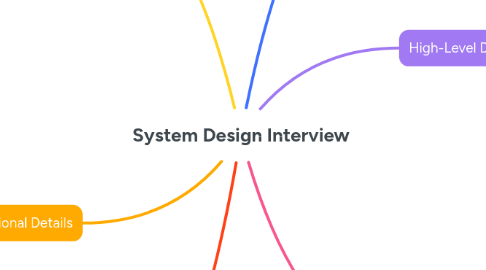
1. Overview
1.1. Introductions
1.2. Overview of the interview process
1.3. High-level problem description
1.3.1. Example: "Design a scalable video streaming platform"
2. Requirements
2.1. Ask clarifying questions
2.1.1. What are the key features?
2.1.2. Who are the users?
2.1.3. What is the scale expected?
2.2. Functional Requirements
2.2.1. What the system **should do**
2.2.2. Example: upload video, stream video, comment system
2.3. Non-functional Requirements
2.3.1. Scalability
2.3.2. Availability
2.3.3. Performance (latency, throughput)
2.4. Assumptions
2.4.1. Request volume (e.g. 1M users/day)
2.4.2. Data size
2.4.3. Traffic pattern
3. High-Level Design
3.1. Core components / services
3.1.1. Client (Web/App)
3.1.2. API Gateway
3.1.3. Application Servers
3.1.4. Database & Storage
3.2. Justify architectural choices
3.2.1. Example: REST vs gRPC, Monolith vs Microservice
3.3. Interaction diagram
4. Functional Details
4.1. Zoom into critical component
4.1.1. API design (methods, endpoints)
4.1.2. Database schema (ERD / indexes)
4.1.3. Data consistency and transactions
4.2. Detail flow of requests (read/write, error cases)
5. Scalability
5.1. Database scaling
5.1.1. Sharding
5.1.2. Replication
5.2. Caching strategy
5.2.1. Redis / Memcached
5.2.2. What to cache and invalidation
5.3. Load balancing
5.4. Message queues / Async processing
5.5. CDN usage / Geographical distribution
6. Next Steps
6.1. Monitoring and Observability
6.1.1. Logging
6.1.2. Metrics
6.1.3. Tracing
6.2. Security concerns
6.2.1. Authentication / Authorization
6.2.2. Rate limiting / Data encryption
6.3. Questions for interviewer
6.3.1. Scope
6.3.2. What constraints to prioritize (cost, latency, complexity)