


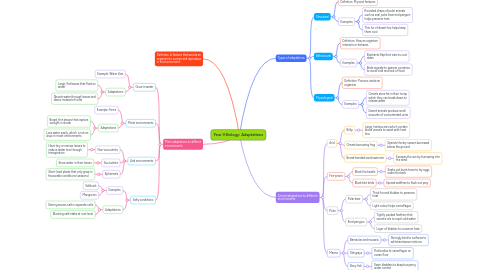
1. Defintion: A feature that assists an organism to survive and reproduce in its environment:
2. Plant adaptations to differnt environments
2.1. Grow in water
2.1.1. Example: Water lilies
2.1.2. Adaptations
2.1.2.1. Large, flat leaves that float on water
2.1.2.2. Absorb water through leaves and stems instead of roots
2.2. Moist environments
2.2.1. Example: Ferns
2.2.2. Adaptations
2.2.2.1. Broad, thin leaves that capture sunlight in shade
2.2.2.2. Lose water easily, which is not an issue in moist environments
2.3. Arid environments
2.3.1. Non-succulents
2.3.1.1. Have tiny or narrow leaves to reduce water loss through transpiration
2.3.2. Succulents
2.3.2.1. Store water in their leaves
2.3.3. Ephermals
2.3.3.1. Short lived plants that only grow in favourable conditions (seasons)
2.4. Salty conditions
2.4.1. Examples
2.4.1.1. Saltbush
2.4.1.2. Mangroves
2.4.2. Adaptations
2.4.2.1. Storing excess salt in separate cells
2.4.2.2. Blocking salt intake at root level
3. Types of adaptations
3.1. Structural
3.1.1. Defintion: Physical features
3.1.2. Examples
3.1.2.1. Rounded shape of polar animals such as seal, polar bear and penguin helps preserve heat
3.1.2.2. Thin fur of desert fox helps keep them cool
3.2. Behavioural
3.2.1. Defintion: How an organism interacts or behaves
3.2.2. Examples
3.2.2.1. Elephants flap their ears to cool down
3.2.2.2. Birds migrate to warmer countries to avoid cold and lack of food
3.3. Physiological
3.3.1. Definition: Process inside an organism
3.3.2. Examples
3.3.2.1. Camels store fat in their hump which they can break down to release water
3.3.2.2. Desert animals produce small amounts of concentrated urine
4. Animal adaptations to different environments
4.1. Arid
4.1.1. Bilby
4.1.1.1. Large, hairless ears which contain blood vessels to assist with heat loss
4.1.2. Ornate burrowing frog
4.1.2.1. Spends the dry season burrowed below the ground
4.1.3. Broad-banded sand swimmer
4.1.3.1. Escapes the sun by burrowing into the sand
4.2. Fire-prone
4.2.1. Black fire beetle
4.2.1.1. Seeks out burnt trees to lay eggs under the bark
4.2.2. Black kite birds
4.2.2.1. Spread wildfires to flush out prey
4.3. Polar
4.3.1. Polar bear
4.3.1.1. Thick fur and blubber to preserve heat
4.3.1.2. Light colour helps camoflague
4.3.2. Kind pengiun
4.3.2.1. Tightly packed feathers that secrete oils to repel cold water
4.3.2.2. Layer of blubber to conserve heat
4.4. Marine
4.4.1. Barnacles and mussels
4.4.1.1. Strongly bind to surfaces to withstand wave motions
4.4.2. Stingrays
4.4.2.1. Flat bodies to camoflague on ocean floor
4.4.3. Bony fish
4.4.3.1. Swim bladders to keep buoyancy under control