


ASSESSMENT
Aneta Węgierakにより
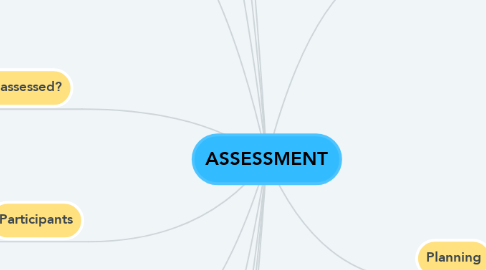
1. Types
1.1. Informal
1.2. Formal
2. Types
2.1. Subjective
2.2. Objective
3. Forms
3.1. Spoken
3.2. Written
4. Purpose
4.1. To check students knowledge
4.2. To motivate students
4.3. To assign the reports
4.4. To help students set learning goals
4.5. TO PROVIDE FEEDBACK ON THE LEARNING PROCESS
5. School obligations
5.1. develop assessment procedures
5.2. develop assessment methods
6. Participants
6.1. Students
6.2. Teachers
6.3. Parents
7. What is assessed?
7.1. the process of inquiry
7.2. the products of inquiry
8. Assessment component
8.1. assessing
8.1.1. how we discover what students know and have learned
8.2. recording
8.2.1. how we choose to collect and analyse data
8.3. reporting
8.3.1. how we choose to communicate information
8.3.1.1. conferences
8.3.1.1.1. teacher-student
8.3.1.1.2. teacher-parent
8.3.1.1.3. student-led
8.3.1.1.4. three way
8.3.1.2. the written report
9. Effectiveness
9.1. sharing the knowledge and skills
9.2. using variety learning styles
9.3. participating in reflection tasks
9.4. planning
9.5. gathering evidence
9.6. seeing evidence of learning
10. Strategies
10.1. observations
10.2. performance assessments
10.3. process - focused assessments
10.4. selected responses
10.5. open-ended tasks
11. Tools
11.1. rubrics
11.2. exemplars
11.3. checklists
11.4. anecdotal records
11.5. continuums
12. Types
12.1. Pre - assessment
12.2. Formative assessment
12.2.1. assessment for learning
12.3. Summative assessment
12.3.1. assessment of learning
12.4. Self assessment
12.4.1. Student self assessment
12.4.2. teacher self assessment
13. Planning
13.1. What will students learn?
13.1.1. What should they learn? - curriculum
13.1.2. Set the goals
13.1.2.1. individual goals
13.1.2.2. group goals
13.2. How will we know that the learning has occurred?
13.3. How will we collect the evidence of learning?
13.3.1. observations checklists
13.3.2. portfolios
13.3.3. worksheets
13.3.4. oral tasks