

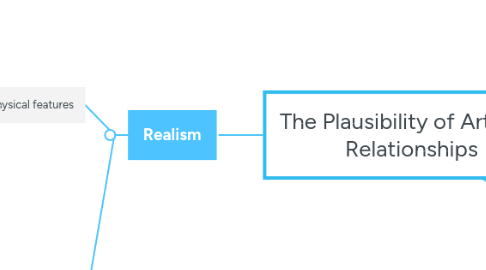
1. Realism
1.1. physical features
1.1.1. IPEFiC
1.1.1.1. form realism https://link-springer-com.ezproxy.library.ubc.ca/article/10.1007%2Fs12369-015-0301-3
1.1.1.1.1. Form Realism is: (a) physical appearance (b) physically, the robot should replicate the organism it is mimicking (animal, human, etc.)
1.2. "social robots" https://link-springer-com.ezproxy.library.ubc.ca/article/10.1007%2Fs12369-015-0301-3
1.2.1. robots taking over tasks in the healthcare industry
2. AI & Emotions
2.1. OCC theory
2.1.1. PUMAGOTCHI (virtual pet) https://link-springer-com.ezproxy.library.ubc.ca/article/10.1007%2Fs12652-011-0089-4
2.1.1.1. Structured to feel emotions
2.1.1.1.1. Simulate Human Behaviour
2.1.2. Virtual pets
2.1.2.1. Requiring human engagementhttps://dl-acm-org.ezproxy.library.ubc.ca/citation.cfm?id=763957
2.1.3. Satisfying Goals (Main Goal & Subgoals)
2.2. AC (Affective Computing)
2.2.1. "A decision making process"https://link-springer-com.ezproxy.library.ubc.ca/article/10.1007%2Fs12652-011-0089-4
2.2.1.1. "Form an emerging behaviour" https://link-springer-com.ezproxy.library.ubc.ca/article/10.1007%2Fs12652-011-0089-4
2.2.1.1.1. http://kali.azc.uam.mx/clc/02_publicaciones/material/AffectArchImplTeacLear_10.pdf
3. Likelihood for a bond to form
3.1. https://scholar-google-com.ezproxy.library.ubc.ca/scholar_lookup?title=Persuasive%20technology%3A%20using%20computers%20to%20change%20what%20we%20think%20and%20do&author=BJ.%20Fogg&publication_year=2003
3.2. A feeling of responsibility/ Need to maintain the relationship
3.2.1. seeing the robot as a human counterpart
3.2.1.1. http://onlinelibrary.wiley.com.ezproxy.library.ubc.ca/doi/10.1111/j.1540-4560.2009.01613.x/full