

1. VIRAL VECTORS
1.1. CHALLENGES
1.1.1. transient/low expression
1.1.2. immune response (to vector or gene)
1.1.3. targeting/delivering to specific tissues/cells
1.1.4. insertional mutagenesis - activate proto-oncogene = induce CANCER
1.2. RETROVIRUS (RNA)
1.2.1. Lentivirus (ex. HIV)
1.2.1.1. most common, efficient
1.2.2. INTEGRATES
1.2.2.1. BOTH dividing & non-dividing cells
1.2.2.2. preferentially into coding regions
1.2.3. 8kb of DNA
1.3. ADENO-ASSOCIATED VIRAL VECTORS
1.3.1. NON-INTEGRATION
1.3.2. stable episome
1.3.2.1. BOTH dividing & non-dividing cells
1.3.2.2. long-term expression
1.3.3. 5kb of DNA
1.3.4. non-pathogenic
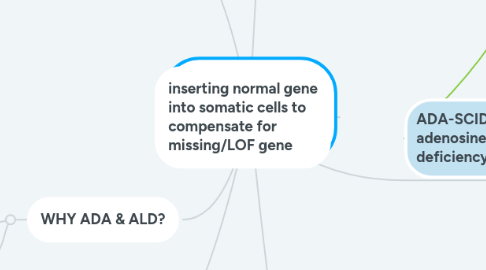
2. inserting normal gene into somatic cells to compensate for missing/LOF gene
3. WHY ADA & ALD?
3.1. Stem cells easily adjusted EX VIVO and re-infused
3.2. poor treatment options, poor prognosis
4. GENE EDITING THERAPY
4.1. engineered endonuclease creates double-stranded break in DNA
4.1.1. induces cell repair
4.1.1.1. non-homologous end-joining
4.1.1.2. homology-direct repair
4.1.1.2.1. provide GOOD wildtype template
4.2. CRISPR/CAS9
4.2.1. MECHANISM
4.2.1.1. guide RNA directs nuclease to target DNA
4.2.1.2. Cas9 endonuclease creates double stranded break
4.2.2. EITHER NHEJ OR HDR
4.2.2.1. NHEJ
4.2.2.1.1. Knock-out gene of interest
4.2.2.1.2. restore out-of-frame transcript
4.2.2.2. HDR
4.2.2.2.1. correct gene with desired copy of gene
4.2.3. sickle-cell anemia, beta-thalassemia
5. ADA-SCID adenosine-deaminase deficiency
5.1. high adenosine, dAMP, dATP
5.1.1. LYMPHOTOXICITY induces apoptosis of developing thymocytes
5.1.1.1. SCID
5.1.1.1.1. no cell/humoral immunity
5.1.1.1.2. lymphopenia = no T-cells, B-cells, NK-cells
5.1.1.1.3. severe recurrent infections
5.1.1.1.4. death by age 2
5.1.2. induces apoptosis of developing thymocytes
5.2. TREATMENTS
5.2.1. ADA-GENE REPLACEMENT THERAPIES
5.2.1.1. EX-vivo CD34+ stem cells with normal gene
5.2.1.2. approved by EU - working well 100% survival
5.2.2. ENZYME REPLACEMENT
5.2.2.1. PEG-ADA
5.2.2.1.1. $$$
5.2.2.1.2. weekly injections
5.2.2.1.3. loses efficacy over time
5.2.3. STEM CELL TRANSPLANT
5.2.3.1. HLA-sibling
5.2.3.2. most recommended by LIMITED
6. Adrenoleukodystrophy (ALD) FATTY ACID METABOLISM DEFECT
6.1. RARE, X-linked
6.1.1. Childhood cerebral form 35%
6.1.2. Onset boys, ages3-10
6.1.3. disability - death by age 2
6.2. mutation in ABCD1 gene for ALD protein = peroxisomal membrane transporter for very long-chain FAs
6.2.1. VLC-FAs need to be oxidized in peroxisomes to MC-FAs prior to metabolism
6.2.2. accumulation of VLC-FAs in brain =immune response = demyelination
6.2.2.1. neurological deterioation
6.3. adrenal cortex dysfunction
6.3.1. corticosteroid treatment
6.4. TREATMENT
6.4.1. allogenic hematopoietic stem cell transplant
6.4.1.1. effective only in early stages
6.4.1.2. limited availability
6.4.2. LENTI-D gene therapy
6.4.2.1. arrests cerebral demyelination
6.4.2.2. free of disability
6.4.2.3. safe alternative
7. GENE - BLOCKING THERAPIES
7.1. ANTISENSE THERAPY
7.1.1. oligonucleotide (DNA/RNA) complementary to mRNA of GOF mutation
7.1.1.1. mRNA degradation
7.1.1.2. translation inhibition
7.1.1.3. splicing modulation
7.1.2. DMD
7.1.2.1. skip exon to produce better dystrophin protein
7.1.3. anti-cancer
7.1.3.1. block expression of oncogenes
7.2. RNA INTERFERENCE (RNAi)
7.2.1. dsRNA complementary to mutant mRNA
7.2.2. incoporated into RISC complexes - targeted for destruction
7.2.3. siRNA-RISC complex is catalytic
7.2.3.1. single complex can destroy many mutant mRNA
7.3. FOR GOF OR DOMINANT NEGATIVE MUTATIONS
7.4. HYPERCHOLESTEREMIA - LDLR unable to remove LDL from plasma
7.4.1. STATINS
7.4.1.1. side effects
7.4.1.2. poor efficacy in some
7.4.2. INCLISIRAN = GENE BLOCKING PCSK9
7.4.2.1. siRNA complementary to PCSK9
7.4.2.1.1. RISC degrades PCSK9
7.4.2.1.2. double stranded RNA - highly stable
7.4.2.2. triantennary GalNAc carbohydrate directs drug specifically to liver
7.4.2.3. increased LDLR for more cholesterol uptake
7.4.2.3.1. decrease cholesterol in plasma