

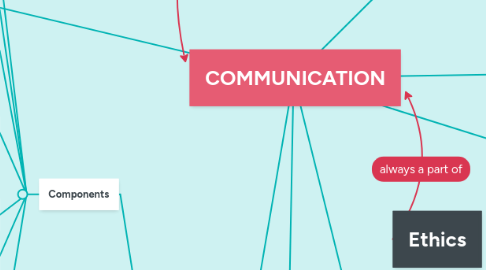
1. Globalization
1.1. Dimensions
1.1.1. Political
1.1.2. Economic
1.1.3. Cultural
1.1.4. Ecological
1.1.5. Ideological
1.2. Effects
1.2.1. Rise of World Englishes
1.2.2. Electronic / Digital Communication
1.2.3. Cultural Globalization
2. Process
2.1. Components
2.1.1. Sender/Receiver
2.1.2. Receiver/Sender
2.1.3. Message
2.1.4. Channel
2.1.4.1. Traditional
2.1.4.2. Technology-mediated
2.1.4.3. Mass communication
2.1.5. Interference
2.1.6. Feedback
2.1.7. Context
2.1.7.1. Power and status relationship
2.1.7.2. Cultural factors
2.1.7.3. Interpersonal relationship
2.1.7.4. Time
2.2. Models
2.2.1. Sender-Message-Receiver
2.2.2. Source-Message-Channel-Receiver
2.2.3. Transactional Model of Communication
2.2.4. Tubbs' Communication Model
2.2.5. Eunson's Communication Model
3. Multimodal
3.1. Semiotic System
3.1.1. Linguistic
3.1.2. Visual
3.1.3. Aural
3.1.4. Spatial
3.1.5. Gestural
3.2. Consider
3.2.1. What is the message?
3.2.2. What is the purpose of the message?
3.2.3. How is the message conveyed by the text or image?
3.2.4. Who is the target audience of the message?
3.3. Evaluation
3.3.1. Critical Reading
3.3.2. Critical Listening
3.3.3. Critical Viewing
3.3.3.1. Camera Shots (Subject)
3.3.3.1.1. Long Shot
3.3.3.1.2. Medium Long Shot
3.3.3.1.3. Medium Shot
3.3.3.1.4. Close-up
3.3.3.1.5. Extreme Close-up
3.3.3.2. Camera Shots (Angle)
3.3.3.2.1. High Angle
3.3.3.2.2. Tilt
3.3.3.2.3. Bird's Eye View
4. Social Media Age
4.1. Social Media
4.1.1. Facebook
4.1.2. Twitter
4.1.3. LinkedIn
4.1.4. Google+
4.2. Presentations
4.2.1. Web-Based Presentation
4.2.1.1. Prezi, Mentimeter, Slide Dog, Flow Vella, Canva, Microsoft Sway
4.2.2. Audio Visual Presentation
4.2.2.1. Bullet
4.2.2.2. Illustration-dependent
4.2.2.3. Speaker prop
4.2.3. Recorded Research Presentation
4.3. Effects and Changes
4.3.1. Appropriating existing vocabulary
4.3.2. Introducing new vocabulary
4.3.3. Generational Language Gap
5. Connotative senses of words
6. Denotative senses of words
7. MAC Proposal
8. Multicultural
8.1. Cultural Literacy
8.2. Types
8.2.1. National Culture
8.2.2. Corporate Culture
8.3. Culture Appropriation
8.4. Culture Appreciation
8.5. World Englishes
8.5.1. American English, Australian English, British English, Canadian English, Caribbean English, Chinese English, Indian English, Japanese English, Spanglish, Taglish, among others
8.6. Cultural Competence
8.7. Interviewing
8.7.1. Global task and function
8.7.2. Personal skills
8.7.3. Interpersonal, socio-linguistic, and pragmatic skills
9. Modes
9.1. Interpretive Communication
9.2. Interpersonal Communication
9.3. Presentational Communication
10. Types
10.1. Verbal
10.1.1. Oral
10.1.2. Written
10.2. Non-Verbal
10.2.1. Paralinguistics
10.2.2. Extralinguistics