


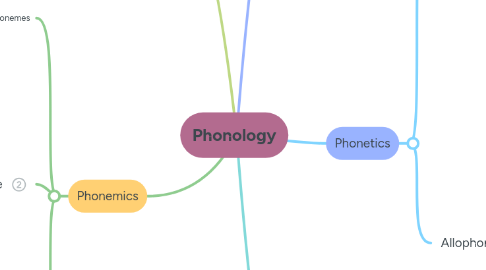
1. Science of speech sounds
1.1. aims
1.1.1. To discover the principles that govern the way sounds are organized.
1.1.2. To explain the variations.
2. Phonemics
2.1. Study of phonemes
2.1.1. aspects
2.1.1.1. Establishment
2.1.1.2. Description
2.1.1.3. Occurrence
2.1.1.4. Arrangement
2.1.2. deals with
2.1.2.1. How speech is perceived once is heard
2.2. Phoneme
2.2.1. Smallest unit of sound significant in a language
2.2.1.1. Vowels
2.2.1.2. Consonants
2.2.2. Written between slashes / /
2.3. English
2.3.1. There are 26 graphemes but 44 phonemes
2.3.1.1. Examples
2.3.1.1.1. Vowels
2.3.1.1.2. Consonants
3. Group 5 members:
3.1. - Verónica Lara - Doménica Larrea - Martina Londoño - Adrián Molina - Emily Menéndez
4. Phonetics
4.1. Study of speech sounds
4.1.1. types
4.1.1.1. Acoustic phonetics
4.1.1.1.1. focuses on
4.1.1.2. Articulatory phonetics
4.1.1.2.1. focuses on
4.1.1.3. Auditory phonetics
4.1.1.3.1. focuses on
4.2. Allophones
4.2.1. Phonetically distinct variants of a phoneme
4.2.1.1. classified into two groups
4.2.1.1.1. Complementary
4.2.1.1.2. Free-variant
4.2.1.2. in terms of
4.2.1.2.1. aspiration, voicing, point of articulation, etc.
4.2.2. Ocurrence
4.2.2.1. determined by
4.2.2.1.1. its position in the word (initial, final, medial.)
4.2.3. Written between brackets [ ]
4.2.3.1. Examples
4.2.3.1.1. /t/: tip, little, hit
4.2.3.1.2. Pronunciation of ED
4.2.3.1.3. /l/: black, call