

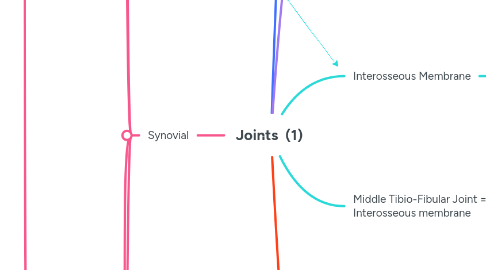
1. Synovial
1.1. Non-axial (plane)
1.1.1. Plane
1.1.1.1. Superior tibio-fibular joint
1.1.1.1.1. Articular surfaces
1.1.1.2. Intervertebral joint (Zygapophyseal joints)
1.1.1.2.1. They are formed between
1.1.1.2.2. allowing
1.1.1.2.3. Articular surfaces
1.1.1.2.4. Fibrous capsule
1.1.1.3. Inter-carpal joint
1.1.1.4. Inter-tarsal joint
1.1.1.5. Bart from joint of shoulder girdle: Acromioclavicular joint
1.1.1.5.1. Articular surfaces
1.1.1.5.2. Accessory ligaments
1.1.1.5.3. Movements of shoulder girdle /movements of scapula
1.1.1.6. Carpometacarpal joints of medial 4 fingers
1.1.1.7. 1) Right and left lateral atlanto-axilal joints
1.1.1.7.1. Between
1.1.1.7.2. Capsule In lateral atlanto-axial joints
1.1.1.7.3. Movements
1.1.2. Movement: gliding
1.2. Uni-axial
1.2.1. Hinge
1.2.1.1. Elbow joint
1.2.1.1.1. Articular surfaces
1.2.1.1.2. Accessory ligaments
1.2.1.1.3. Movements
1.2.1.2. Ankle joint
1.2.1.2.1. Articular surfaces
1.2.1.2.2. Ligaments of Ankle Joint
1.2.1.2.3. Sprain (torn fibers) of the lateral ligament of the ankle joint
1.2.1.2.4. Relations of ankle joint
1.2.1.2.5. N. supply
1.2.1.2.6. Movements
1.2.1.3. Inter phalangial joint
1.2.1.3.1. Movements of medial 4 fingers
1.2.1.4. Movement: flexion & extension
1.2.1.5. Metacarpophalangeal joint of thumb
1.2.1.5.1. Movements
1.2.2. Pivot
1.2.2.1. Superior radio-ulnar joint
1.2.2.1.1. Articular surfaces
1.2.2.1.2. Annular ligament
1.2.2.2. Inferior radio-ulnar joint
1.2.2.2.1. Articular surfaces
1.2.2.2.2. Articular disc
1.2.2.2.3. Movements of radio-ulnar joints
1.2.2.3. Movement: Rotation
1.2.2.4. 2) Median atlanto-axial joint
1.2.2.4.1. between
1.2.2.4.2. Capsule In median atlanto-axial joint
1.2.2.4.3. Movements
1.3. Bi-axial
1.3.1. Condylar
1.3.1.1. Temporo-mandibular joint
1.3.1.1.1. Articular surfaces
1.3.1.1.2. [N.B.]
1.3.1.1.3. Fibrous capsule
1.3.1.1.4. Articular disc
1.3.1.1.5. Ligaments of TMJ
1.3.1.1.6. Movements of TMJ
1.3.2. Bicondylar
1.3.2.1. Knee joint
1.3.2.1.1. The knee joint represents 3 joints which are originally separate
1.3.2.1.2. Articular surfaces
1.3.2.1.3. Fibrous capsule
1.3.2.1.4. Extracapsular ligaments
1.3.2.1.5. 7 Intra-articular Structures
1.3.2.1.6. Relations of knee joint
1.3.2.1.7. 4 Movements
1.3.2.1.8. Locking and unlocking of the knee joint
1.3.3. Ellipsoid
1.3.3.1. Wrist joint
1.3.3.2. Metacarpophalangeal joint of medial 4 fingers
1.3.3.2.1. 1- Flexion
1.3.3.2.2. 2- Extension
1.3.3.2.3. 3- Abduction
1.3.3.2.4. 4- Adduction
1.3.3.3. Atlanto-occipital Joint
1.3.3.3.1. Articular surfaces
1.3.3.3.2. Capsule
1.3.3.3.3. Ligaments
1.3.3.3.4. Movements
1.3.4. Saddle
1.3.4.1. Carpo-metacarpal joint of thumb
1.3.4.1.1. Movements
1.3.4.2. Part from joint of shoulder girdle: Sterno-clavicular joint
1.3.4.2.1. Articular surfaces
1.3.4.2.2. Accessory ligaments
1.4. Multi-axial
1.4.1. Ball and socket
1.4.1.1. Shoulder joint
1.4.1.1.1. Articular surfaces
1.4.1.1.2. Fibrous capsule → Attached
1.4.1.1.3. Accessory ligaments
1.4.1.1.4. Stability of the joint
1.4.1.1.5. Movements
1.4.1.2. Hip joint
1.4.1.2.1. Articular surfaces
1.4.1.2.2. The labrum acetabulare
1.4.1.2.3. A. Extracapsular Ligaments
1.4.1.2.4. B. Intracapsular Ligaments
1.4.1.2.5. Relations of the joint
1.4.1.2.6. Movement
1.4.1.2.7. Joint stability
1.4.2. Movement: Flexion,Extension,Addiction,Abduction,Medial rotation,Lateral rotation
2. Fibrous
2.1. Sutures
2.1.1. Sutural ligament
2.1.1.1. Skull
2.2. Gomphosis
2.2.1. Periodontal Ligament
2.2.1.1. Jaws
2.3. Syndesmosis
2.3.1. Interosseous ligament
2.3.1.1. Inferior tibio-fibular joint
2.3.1.1.1. Articular surfaces
2.3.1.1.2. 4 Tibio-fibular Ligs.
3. Cartilaginous
3.1. Primary cartilaginous
3.1.1. Epiphyseal plate
3.2. Secondary cartilaginous
3.2.1. Inter-vertebral discs (Vertebral symphysis)
3.2.1.1. Articular surfaces
3.2.1.1.1. a) Vertebral end-plates
3.2.1.1.2. b) Intervertebral disc
3.2.1.2. Structure of the disc
3.2.1.2.1. the disc consists of 2 parts
3.2.2. Symphysis pubis
3.2.3. Slight movement (limited mobility)
3.2.4. LUMBO-SACRAL JOINT
3.2.4.1. THE INTERVERTEBRAL DISC IS THICKER THAN OTHERS
3.2.4.1.1. TO ALLOW MORE MOVEMENT.
3.2.4.2. THE DISC IS THICKER IN FRONT MORE THAN BEHIND → ERECT POSTURE.
4. Interosseous Membrane
4.1. It extends between the interosseous borders of both radius and ulna.
4.2. Direction of fibers
4.2.1. obliquely downwards and medially from radius to ulna.
4.3. Features
4.3.1. It has a gap between its upper border and the oblique cord that transmits the posterior interosseous vessels to the back of the forearm.
4.3.2. It has a small oval gap near the wrist that transmits the anterior interosseous artery to the back of the forearm.
5. Middle Tibio-Fibular Joint = Interosseous membrane
5.1. Direction of its fibers
5.1.1. down & lat.
5.2. Functions of middle T/F joint (interosseous membrane)
5.2.1. a. Binds tibia to fibula.
5.2.2. b. Gives additional surfaces for muscle attachment.
6. Arches of foot
6.1. Medial Longitudinal Arch
6.1.1. Kinetic arch
6.1.1.1. (imp. in walking or running)
6.1.2. Parts
6.1.2.1. 1- Summit (Talus)
6.1.2.2. 2- Post. pillar (Calcaneus)
6.1.2.3. 3- Ant. pillar
6.1.2.3.1. Navicular
6.1.2.3.2. 3 cuneiforms
6.1.2.3.3. med. 3 metatarsal bones
6.2. Lateral Longitudinal Arch
6.2.1. Static arch
6.2.1.1. (imp. in standing)
6.2.2. Parts
6.2.2.1. 1- Summit (Talus)
6.2.2.2. 2- Post. pillar (Calcaneus)
6.2.2.3. 3- Ant. pillar
6.2.2.3.1. Cuboid
6.2.2.3.2. lat. 2 metatarsal bones
6.3. Transeverse Arch
6.3.1. Protective arch
6.3.1.1. (prevents compression of plantar vessels & nerves)
6.3.2. Between all the metatarsal bones
6.3.3. Incomplete arch
6.3.3.1. as its med. end does not touch the ground, so both feet form a complete arch.
6.4. Applied Anatomy = Flat Foot
6.4.1. Due to
6.4.1.1. 1- Bone diseases.
6.4.1.2. 2- Debilitating diseases.
6.4.1.3. 3- M. paralysis.
6.4.2. Predisposing factors
6.4.2.1. 1- Obesity.
6.4.2.2. 2- Carrying heavy objects.
6.4.2.3. 3- Prolonged bad posture in bad shoes.
6.4.3. Clinical picture
6.4.3.1. 1- Pain in the foot referred to leg.
6.4.3.2. 2- The patient cannot stand, walk or run for a long time.