
Democracy

Explore an in-depth journey into the world of democracy with our comprehensive mind map, encompassing everything from its meaning to its presence across the globe. The mind map simplifies the complex topic of democracy, covering its definition, principles, underlying mechanisms, challenges, and benefits. It also provides an insight into the different types of democracy, namely direct, representative, constitutional, and social, with examples from various countries like the U.S., U.K., Switzer...

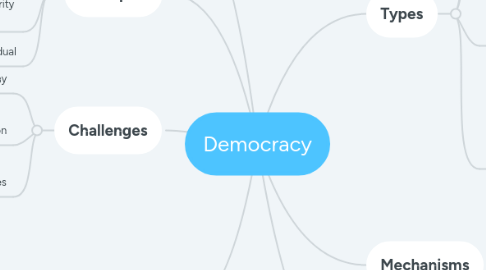
1. Definition
1.1. Rule by the people
1.2. Equality based
1.3. Inclusion of individuals
2. Principles
2.1. Political equality
2.2. Popular sovereignty
2.3. Majority rule and minority rights
2.4. Freedom of the individual
3. Challenges
3.1. Voter apathy
3.1.1. Low voter turnout
3.1.2. Political disengagement
3.2. Corruption
3.2.1. Abuse of power
3.3. Decline of civil liberties
3.3.1. Surveillance
3.3.2. Censorship
4. Democracy around the world
4.1. Global spread of democratic nations
4.2. Democratic transitions in recent history
4.2.1. Fall of Soviet Union
4.2.2. Arab Spring
4.3. Differences in democracies globally
4.3.1. Variations in representative systems
4.3.2. Degree of protections for minority rights
4.3.3. Levels of press freedom and censorship.
5. Types
5.1. Direct Democracy
5.1.1. Citizens make decisions directly
5.1.2. Switzerlands Cantons
5.2. Representative Democracy
5.2.1. Elected individuals represent a group of people
5.2.2. Most countries
5.2.2.1. United States
5.2.2.2. United Kingdom
5.3. Constitutional Democracy
5.3.1. Power is balanced by a constitution
5.3.2. United States
5.4. Social Democracy
5.4.1. Political ideology focuses on social justice within the framework of capitalism
5.4.2. Scandinavian countries
5.4.2.1. Sweden
5.4.2.2. Denmark
5.4.2.3. Norway
6. Mechanisms
6.1. Fair and free elections
6.2. Citizen participation
6.3. Protection of human rights
6.3.1. Freedom of speech
6.3.2. Freedom of assembly