


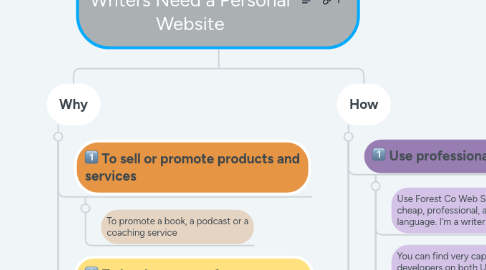
1. Why
1.1. To sell or promote products and services
1.1.1. To promote a book, a podcast or a coaching service
1.2. To be the owner of your content
1.2.1. Having a website with a blog “safeguards” the content you’ve created.
1.2.2. Companies like Medium or Quora own the content.
1.2.2.1. If they go down for any reason, your content is gone. Serious writers don’t want that.
1.2.2.2. Medium has guidelines to follow, for example, but on your website, you can do whatever you want.
1.3. To make money from your blog
1.3.1. You can make money from your blog using popular methods like ads, product placement, and affiliate marketing.
1.3.2. People are willing to pay you to put a simple backlink to their website on your blog
1.3.3. Some also pay to guest post on your blog.
1.3.4. The more popular your blog becomes the more of those requests you’ll get. You can earn good money with little effort.
1.4. To be taken seriously
1.4.1. 99 percent of Medium writers don’t have a website. If you have one, you stand out.
1.4.2. It shows commitment to your craft.
1.4.3. Because of that, your readers tend to react more positively to your posts and are more likely to follow you.
1.5. To have a central point of contact for your readers
1.5.1. Serious Medium writers tend to also write in other publications outside of Medium, and also on Quora and LinkedIn.
1.5.2. Some writers even have a Youtube channel
1.5.3. Your website is the only central location where your audience can see what you’re up to, buy from you, and contact you.
2. How
2.1. Use professional services
2.1.1. Use Forest Co Web Services. We are quick, cheap, professional, and speak the same language. I’m a writer too after all!
2.1.2. You can find very capable website developers on both Upwork and Fiverr, for example.
2.1.3. You can also do a simple Google search with these keywords: “personal website”, “creation”, “service”, etc.
2.2. Use Squarespace, Wix or Wordpress
2.2.1. Squarespace is the easiest to use and includes everything you might need without the complexity of Wordpress.
2.2.2. Wix is a cheaper and popular service. Some people find it more intuitive to use than Squarespace.
2.2.3. Wordpress is the most widely used, but also the most complicated one of the three.
2.2.4. Wordpress websites are harder to maintain but are cheap, supposedly more SEO-friendly, and highly customizable.
2.3. Use templates
2.3.1. You can also start from a template, update it, and host it on a website host like HostGator.com or BlueHost.com.
2.3.2. W3Schools has great templates to start from.
2.3.3. So does Colorlib
2.3.4. This will require you to get into the code to make updates, so this is not an easy option for non-technical people.
2.4. Use Shopify
2.4.1. If you plan on selling products online, nothing beats Shopify. Their tools are top-notch and very easy to use.
2.4.2. Shopify also has excellent tutorials to show you how to do anything on their platform and their customer support is excellent.
2.4.3. Shopify is more expensive than Squarespace, and it focuses on one aspect: selling products.
2.5. Ask a student
2.5.1. Computer science students are eager and cheap or free.
2.5.2. They learn the latest technologies and can usually build websites within less than a week.
2.5.3. If you live near a college or university, you might be able to drop by and ask faculty administrators.
2.5.4. You might be able to post an ad as well.