


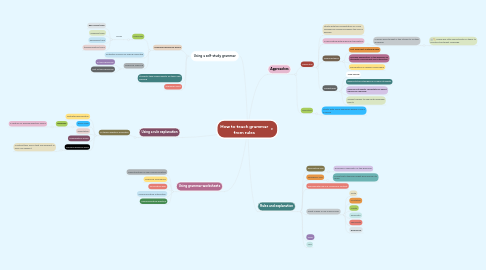
1. Using a rule explanation
1.1. To teach question formation
1.1.1. Ilustrated explanation
1.1.2. word order
1.1.2.1. Inversion
1.1.2.1.1. A feature of English question forms
1.1.3. Adaptation
1.1.4. Grammatical forms
1.1.5. Minimal grammar pairs
1.1.5.1. Contrast two forms that are different in only one respect
2. Using grammar worksheets
2.1. Opportunities for real communication
2.2. Grammar summaries
2.3. Information gap
2.4. Communicative interaction
2.5. Communicative practice
3. Using a self-study grammar
3.1. Grammar reference books
3.1.1. Exercises
3.1.1.1. Types
3.1.1.1.1. gap-filling tasks
3.1.1.1.2. ordering tasks
3.1.1.1.3. expansion task
3.1.1.1.4. transformation tasks
3.1.2. Potential sources of learner-directed
3.1.3. Grammar learning
3.1.3.1. In the classroom
3.1.3.2. Out of the classroom
3.2. Students take responsibility for their own learning
3.3. Grammar input
4. Approaches
4.1. Deductive
4.1.1. Starts with the presentation of a rule followed by examples where the rule is applied
4.1.2. Is associated with grammar-translation
4.1.2.1. Classes were taught in the students' mother language
4.1.2.1.1. There was little opportunity for them to practice the target language
4.1.3. Disadvantages
4.1.3.1. Not sufficient metalanguage
4.1.3.2. Teacher explanation is the expense of students involvement and interaction
4.1.3.3. Explanation is seldom memorable
4.1.4. Advantages
4.1.4.1. Time.saving
4.1.4.2. Respects the intelligence of many students
4.1.4.3. Confirms students' expectations about classroom learning
4.1.4.4. Allows teacher to deal with language points
4.2. Inductive
4.2.1. Starts with some examples where a rule is inferred
5. Rules and explanation
5.1. Descriptive rule
5.1.1. Describe a regularity of the grammar
5.2. Pedagogic rule
5.2.1. A rule that a teacher might give learners to apply
5.3. Appropriate rule in a classroom context
5.4. What makes a rule a good rule?
5.4.1. Truth
5.4.2. Limitation
5.4.3. Clarity
5.4.4. Simplicity
5.4.5. Familiarity
5.4.6. Relevance