


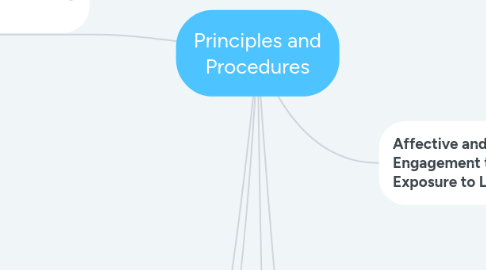
1. Students' Exposure to Quality Language Input
1.1. Spoken and written texts,Variety of text types and genres(Rich,Meaningful and Comprehensible Input of Language use)
1.2. Make sure the language item is authentic
1.3. Make sure that the language input in contextualised(Too much contextualization could be a problem.
1.4. Make sure that the learners are exposed to sufficent samples of laguage in authentic use to provide natural recylcling of language items.
1.5. Examples Of Materials
1.5.1. Task-free activities
1.5.1.1. Involves; reading a poem or story,or telling a joke or anecdote (no questions or tasks are involved,just written copies)
1.5.2. Extensive reading,listening and viewing
2. Positive Affects Help Students Achieve...
2.1. Design Principles
2.1.1. Texts and tasks are as interesting,relevant ant enjoyable as possible so the learners' attitudes towards the lanugage and the learning process are positive
2.1.2. Setting achievable challenges, which help to raise learners' self-esteem
2.1.3. Stimulate emotive responses through the use of: music,literature,art etc. Making use of controversial and provocative texts, through personalisation, through inviting learners to articulate their feelings about a text before asking them to analyse it.
2.2. Examples of Materials
2.2.1. Texts and tasks chosen from the liking of students which are offered by the teacher
2.2.2. Provocative texts
3. Noticing Salient Features
3.1. Experiential approach
4. Affective and Cognitive Engagement to Maximise Exposure to Language
4.1. Learners need to think and feel whilst experincing the language
4.2. Feeling;enjoyment,pleasure,happiness,amusement,excitement and being simulated are most likely to influence acquisition.Feeling annoyanceianger,fear,opposition and sadness is more useful than feeling nothing at all.
4.3. Design Principles
4.3.1. Prioritise the potential for engagement
4.4. Examples of Materials
4.4.1. Text -driven approach;engaging spoken or written text
4.4.2. Readiness activities;which help to activate their minds,prior to experiencing the text, holistic focus to think about when experiencing the text
4.4.3. Encourage them to articulate their personal responses,before going on to use it,to stimulate their own language production
5. L2 Learners Using Mental resources Which Learners utulise when acquiring their L1
5.1. Mental Imaging
5.2. Inner speech
5.3. Emotional Responses
5.4. Connections with their own lives
5.5. Evaluations/predictions
5.6. Personal İnterpretations
5.7. Linguistic decoding/encoding
5.8. Visual İmagin
6. Opportunities To Use the Language
6.1. Gaining Feedback
6.2. Design Principles
6.2.1. Providing Opportunities
6.2.2. Making sure output activites are designed so the learners are using language
6.2.3. Output activites should be contextualized for an authentic stimilus
6.3. Materials
6.3.1. Students produce a text which is a dev. from their new experience.
6.3.2. Materials need to be written in such a way that the teacher can make use of them as a resource and not have to follow them as a script. Tomlinson,B. 2009