


1. Pre-Primary
1.1. HASS Skills
1.1.1. Participate in decision-making processes (e.g. engage in group discussions, make shared decisions) (WAHASS09)
1.1.2. Draw conclusions based on discussions of observations (e.g. answer questions, contribute to guided discussions) (WAHASS08
1.2. English Skills
1.2.1. Use comprehension strategies to understand and discuss texts listened to, viewed or read independently (ACELY1650)
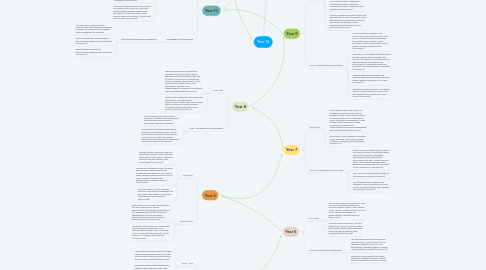
2. Year 11
2.1. General Capabilities (Shared with Year 12)
2.2. Unit 1 - Natural and ecological hazards
2.2.1. Natural and ecological hazards and how they represent potential sources of harm to human life, health, income and property, and may affect elements of the biophysical, managed and constructed elements of environments. Unit also focuses on understanding how these hazards and their associated risks are perceived and managed at local, regional and global levels
2.2.2. Compare and evaluate Australian and international risk management policies, procedures and practices
2.3. Unit 2 - Global networks and interconnections
2.3.1. Focus on the process of international integration (globalisation) and is based on the reality that we live in an increasingly interconnected world.
2.3.2. Unit explains how these advances in transport and communication technology have lessened the friction of distance and have impacted at a range of local, national and global scales
2.3.3. Students required to evaluate the sustainability of alternative futures, drawing on an understanding of an integrated global society
3. Year 10
3.1. Humanities and Social Sciences skills
3.1.1. Identify current personal knowledge, gaps, misconceptions, currency of information, personal perspective and possible perspectives of others (WAHASS79)
3.1.2. Draw evidence-based conclusions by evaluating information and/or data, taking into account ambiguities and multiple perspectives; to negotiate and resolve contentious issues; to propose individual and collective action in response to contemporary events, challenges, developments, issues, problems and/or phenomena (WAHASS90)
3.1.3. Deconstruct and reconstruct the collected information and/or data into a form that identifies the relationship between the information and the hypothesis, using subject-specific conventions, terminology and concepts (WAHASS94)
3.2. Knowledge and understanding
3.2.1. Environmental change and management
3.2.1.1. The application of environmental, economic and social criteria in evaluating management responses to the change being investigated (ACHGK075)
3.2.1.2. The causes and likely consequences of environmental change being investigated (ACHGK073)
3.2.1.3. The strategies to manage the environmental change being investigated (ACHGK074)
4. Year 8
4.1. `HASS Skills
4.1.1. Draw evidence-based conclusions by evaluating information and/or data to generate a range of alternatives and plan for action in response to contemporary events, challenges, developments, issues, problems and/or phenomena; make comparisons; evaluate costs (disadvantages) and benefits (advantages); and infer relationships (WAHASS75)
4.1.2. Develop texts, particularly descriptions and explanations, using appropriate subject-specific terminology and concepts that use evidence to support findings, conclusions and/or arguments, from a range of sources (WAHASS77)
4.2. HASS - Knowledge and Understanding
4.2.1. How the application of principles of prevention, mitigation and preparedness minimises the harmful effects of geomorphic hazards (ACHGK053)
4.2.2. How the effects caused by geomorphic hazards are influenced by social, cultural and economic factors (e.g. where people choose to live, poverty, the available infrastructure and resources to prepare and respond to a hazard) (ACHGK053)
5. Year 6
5.1. HASS Skills
5.1.1. Draw and justify conclusions, and give explanations, based on the information and/or data in texts, tables, graphs and maps (e.g. identify patterns, infer relationships) (WAHASS59)
5.1.2. Use decision-making processes (e.g. share opinions and personal perspectives, consider different points of view, identify issues, develop possible solutions, plan for action, identify advantages and disadvantages of different options) (WAHASS60)
5.1.3. Develop a variety of texts, including narratives, descriptions, biographies and persuasive texts, based on information collected from source materials (WAHASS62)
5.2. HASS Content
5.2.1. Differences in the economic characteristics (e.g. per capita income, energy consumption), demographic characteristics (e.g. population size, density) and social characteristics (e.g. life expectancy, education) of a selection of countries across the world (ACHASSK139)
5.2.2. The world's cultural diversity, including that of its indigenous peoples who live in different regions in the world, such as the Maori of Aotearoa (New Zealand), and the Orang Asli of Malaysia and Indonesia (ACHASSK140)
6. Year 4
6.1. HASS - Skills
6.1.1. Use decision-making processes (e.g. share views, recognise different points of view, identify issues, identify possible solutions, plan for action in groups) (WAHASS36)
6.1.2. Draw conclusions and give explanations, based on the information and/or data displayed in texts, tables, graphs and maps (e.g. show similarities and differences) (WAHASS35)
6.2. HASS - Knowledge and Understanding
6.2.1. The main characteristics (e.g. climate, natural vegetation, landforms, native animals) of the continents of Africa and Europe, and the location of their major countries in relation to Australia (ACHASSK087)
6.2.2. The natural resources (e.g. water, timber, minerals) provided by the environment and different views on how they can be used sustainably (ACHASSK090)
7. Year 2
7.1. HASS Skills
7.1.1. Participate in decision-making processes (e.g. engage in group discussions, make shared decisions, share views) (WAHASS22)
7.1.2. Draw conclusions based on information and/or data displayed in pictures, texts and maps (e.g. form categories, make generalisations based on patterns) (WAHASS21)
7.2. HASS Knowledge and Understandings
7.2.1. The connections of people in Australia to other places in Australia, in the Asia region, and across the world (e.g. family connections, trade, travel, special events, natural disasters)
7.3. English Skills
7.3.1. Use comprehension strategies to build literal and inferred meaning and begin to analyse texts by drawing on growing knowledge of context, language and visual features and print and multimodal text structures (ACELY1670)
8. Unit 3 – Global environmental change
8.1. Assess the impacts of land cover transformations with particular reference to climate change or biodiversity loss.
9. Unit 4 – Planning sustainable places
9.1. Investigate how the outcomes of processes vary depending on local responses and adaptations, for example, population growth and decline, and economic restructuring. Also examine the causes and consequences of urbanisation as well as challenges that exist in metropolitan and regional centres and megacities.
10. Year 9
10.1. HASS Skills
10.1.1. Analyse the 'big picture' (e.g. put information and/or data into different contexts, reconstruct information by identifying new relationships, identify missing viewpoints or gaps in knowledge) (WAHASS88)
10.1.2. Draw evidence-based conclusions by evaluating information and/or data, taking into account ambiguities and multiple perspectives; to negotiate and resolve contentious issues; to propose individual and collective action in response to contemporary events, challenges, developments, issues, problems and/or phenomena (WAHASS90)
10.1.3. Critically evaluate information and/or data and ideas from a range of sources to make generalisations and inferences; propose explanations for patterns, trends, relationships and anomalies; predict outcomes (WAHASS91)
10.2. HASS: Knowledge and Understanding
10.2.1. The environmental, economic and technological factors that influence crop yields in Australia and across the world (e.g. climate, soils, landforms, water resources, irrigation, accessibility, labour supply, agricultural technologies) (ACHGK062)
10.2.2. The effects of anticipated future population growth on global food production and security; the capacity for Australia and the world to achieve food security; the implications for agriculture, agricultural innovation and environmental sustainability (ACHGK064)
10.2.3. The ways that places and people are interconnected with other places through trade in goods and services, at all scales (ACHGK067)
10.2.4. The effects of people's travel, recreational, cultural or leisure choices on places, and the implications for the future of these places (ACHGK069)
11. Year 7
11.1. HASS Skills
11.1.1. Draw evidence-based conclusions by evaluating information and/or data to generate a range of alternatives and plan for action in response to contemporary events, challenges, developments, issues, problems and/or phenomena; make comparisons; evaluate costs (disadvantages) and benefits (advantages); and infer relationships (WAHASS75)
11.1.2. Use criteria to select relevant information and/or data such as accuracy, reliability, currency and usefulness to the question (WAHASS70)
11.2. HASS - Knowledge and understanding
11.2.1. Water scarcity and what causes it, why it is a problem and ways of overcoming water scarcity (e.g. recycling, stormwater harvesting and reuse, desalination, inter-regional transfer of water, reducing water consumption) including studies drawn from Australia, and one from West Asia or North Africa (ACHGK040)
11.2.2. The influence of environmental quality on the liveability of places (ACHGK045)
11.2.3. The strategies used to enhance the liveability of places, especially for young people, including examples from Australia and Europe (ACHGK047)
12. Year 5
12.1. HASS Skills
12.1.1. Use decision-making processes (e.g. share opinions and personal perspectives, consider different points of view, identify issues, develop possible solutions, plan for action, identify advantages and disadvantages of different options) (WAHASS60)
12.1.2. Draw and justify conclusions, and give explanations, based on the information and/or data in texts, tables, graphs and maps (e.g. identify patterns, infer relationships) (WAHASS59)
12.2. HASS Knowledge and Understanding
12.2.1. The way people alter the environmental characteristics of Australian places (e.g. vegetation clearance, fencing, urban development, drainage, irrigation, farming, forest plantations, mining) (ACHASSK112)
12.2.2. Features of environments (e.g. climate, landforms, vegetation) influence human activities and the built features of places
13. Year 3
13.1. HASS Skills
13.1.1. Use decision-making processes (e.g. share views, recognise different points of view, identify issues, identify possible solutions, plan for action in groups) (WAHASS36)
13.1.2. Draw conclusions and give explanations, based on the information and/or data displayed in texts, tables, graphs and maps (e.g. show similarities and differences) (WAHASS35)
13.1.3. Reflect on learning, identify new understandings and act on findings in different ways (e.g. complete a KWL chart, propose action in response to new knowledge) (WAHASS39)
13.2. HASS Knowledge and Understandings
13.2.1. The similarities and differences between places in terms of their type of settlement, the diversity of people (e.g. age, birthplace, language, family composition), the lives of the people who live there, and feelings and perceptions about places (ACHASSK069)
13.3. English Skills
13.3.1. Use comprehension strategies to build literal and inferred meaning and begin to evaluate texts by drawing on a growing knowledge of context, text structures and language features (ACELY1680)
14. Year 1
14.1. HASS Skills
14.1.1. Draw conclusions based on information and/or data displayed in pictures, texts and maps (e.g. form categories, make generalisations based on patterns) (WAHASS21)
14.1.2. Participate in decision-making processes (e.g. engage in group discussions, make shared decisions, share views) (WAHASS22)
14.2. English Skills
14.2.1. Use comprehension strategies to build literal and inferred meaning about key events, ideas and information in texts that they listen to, view and read by drawing on growing knowledge of context, text structures and language features (ACELY1660)
15. General Capabilities
15.1. Students use their literacy skills to explore, interpret and evaluate geographical phenomena and issues and communicate geographically
15.2. students use numeracy skills to identify and describe a wide range of patterns and relationships, including those that can be visually represented on a graph or map. These skills help students to realise and describe change as it occurs over time.
15.2.1. Geographical and statistical data skills (use of geographical and statistical data in formats such as tables, graphs, maps and diagrams) to identify correlations between variables
15.3. Critical and creative thinking processes and skills are used by students when examining diverse interactions between people, perspectives, interpretations, phenomena and environments. Through multifaceted problem posing and solving, they explore the interconnections, uncertainty and consequences of these relationships.
15.4. Apply geographical inquiry and a range of skills, including spatial technologies and fieldwork, to evaluate land cover change and its consequences and sustainable solutions
15.4.1. Evaluate the reliability, validity and usefulness of geographical sources and information
15.4.2. Use geographical language in appropriate contexts to demonstrate geographical knowledge and understanding