
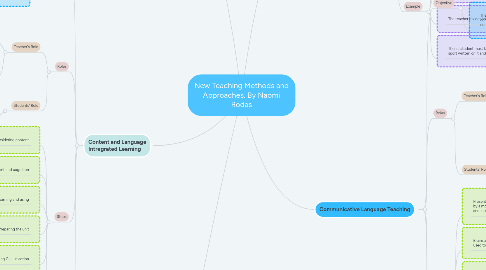
New Teaching Methods and Approaches. By Naomi Rodas

New teaching methods and approaches

1. Task Based Learning
1.1. Description and Objectives
1.1.1. Task-based language learning is an approach where the planning of learning materials and teaching sessions are based around doing a task.
1.1.2. task-based Learning focuses on the use of authentic language and on asking students to do meaningful tasks using the target language.
1.2. Roles
1.2.1. Teacher's Role
1.2.1.1. The teacher’s role is to choose tasks, based on an analysis of students’ needs, that are appropriate to the level of the students and to create pre-task and task follow-up phases that are in line with the abilities and needs of the students
1.2.1.2. The teacher monitors the students’ performance, and intervenes as necessary
1.2.2. Students' Role
1.2.2.1. The role of the students is to communicate with their peers to complete a task.
1.3. Steps
1.3.1. The Pre-Task
1.3.1.1. This is where the teacher introduces the task to the students, and get them excited for the task.
1.3.2. The Task
1.3.2.1. Begin the task
1.3.3. Review
1.3.3.1. Once the learners have completed the task and have something to show, then it’s time for a review.
2. Content and Language Intregrated Learning
2.1. Description
2.1.1. Content and Language Integrated Learning is an approach where students learn a subject and a second language at the same time
2.1.2. The objective is to improve students’ proficiency in both their mother tongue and the target language, attaching the same importance to each.
2.2. Roles
2.2.1. Teacher's Role
2.2.1.1. The teacher should have the ability to teach one or more subjects in the curriculum in a language other than the usual language of instruction and moreover, teach that language itself
2.2.1.2. To help students improve their English BICS (basic interpersonal communicative skills).
2.2.2. Students' Role
2.2.2.1. Students are the main language producers in the class as well as being the main receptors of input
2.3. Steps
2.3.1. Considering content
2.3.2. Connecting content and cognition
2.3.3. Defining language learning and using
2.3.4. Preparing the unit
2.3.5. Monitoring and evaluating CLIL in action
2.3.6. Develop inquiry-based learning communities
2.4. Example
2.4.1. Artwork Presentations
2.4.1.1. These presentations are intended to promote speaking and reading in the target language. Students present on a piece of artwork to the rest of the class. It may even be something you’ve already incorporated into your language classroom
3. Content Based Instruction
3.1. Description and Objective
3.1.1. Refers to an approach to second language teaching in which teaching is organized around the content or information that students will acquire, rather than around a linguistic or other type of syllabus
3.1.2. The goal of CBI is to prepare students to acquire the language while using the context of any subject matter so that students learn the language by using it within that specific context.
3.2. Roles
3.2.1. Teacher's Role
3.2.1.1. The teacher needs to set clear learning objectives for both content and language. The teacher then creates activities to teach both, scaffolding the language needed for study of the content.
3.2.1.2. Being guide in understanding content
3.2.2. Students' Role
3.2.2.1. The students’ role is to engage actively with both content and language, using each to learn the other
3.3. Steps
3.3.1. Use content form other disciplines
3.3.2. Build on students' previous knowledge
3.3.3. Teacher help to scaffold linguistic content
3.3.4. Teacher give examples and use comprehensive checks with authentic matter
3.3.5. Learners use authentic materials to practice language
3.4. Example
3.4.1. Students might have a lesson on British kitchen. This would focus on the British diet and would naturally introduce words such as "Bread" (pan) "tea" (té) and "fish" (pescado) in a meaningful way because the words are presented within the context of the content. This helps students make logical connections between ideas, words and objects.
4. Total Physical Response
4.1. Description
4.1.1. Total Physical Response is a language teaching method built around the coordination of speech and action; it attempts to teach language through physical activity
4.1.2. The general objectives of Total Physical Response are to teach oral proficiency at a beginning level. Comprehension is a means to an end, and the ultimate aim is to teach basic speaking skills.
4.2. Roles
4.2.1. Teacher's Roles
4.2.1.1. The teacher plays an active and direct role in Total Physical Response. The instructor is the director of a stage play in which the students are the actors. It is the teacher who decides what to teach, who models and presents the new materials, and who selects supporting materials for classroom use.
4.2.2. Students' Role
4.2.2.1. Learners in Total Physical Response have the primary roles of listener and performer. They listen attentively and respond physically to commands given by the teacher.
4.2.2.2. Learners are required to respond both individually and collectively.
4.3. Example
4.3.1. To teach sports the teacher must present flashcards about each of them
4.3.2. Students should repeat the name of each sport aloud
4.3.3. The teacher divides the class into two teams
4.3.4. Then a student must take a flashcard and do a performance representing the sport written on it and their teammates must guess.
5. Communicative Language Teaching
5.1. Objective
5.1.1. Successful communication in the target language is the main goal of communicative language teaching.
5.1.2. The focus, particularly in the beginning, is on the student communicating an authentic message in their individual context and making themselves understood.
5.2. Roles
5.2.1. Teacher's Role
5.2.1.1. The major role of the teacher in a CLT classroom is to be a facilitator
5.2.1.2. the roles of the teacher that made her a facilitator included supervising, prompting, explaining, questioning, listening and correcting
5.2.1.3. The teacher is the manager of classroom activities. The teacher is charged with the responsibility of establishing situations likely to promote communication.
5.2.2. Students' Role
5.2.2.1. Students are communicators. They are actively engage in trying to make themselves understood and in understanding others
5.3. Steps
5.3.1. Presentation of a situation or context tthrough a brief dialogue, preceded by a motivational activity relating the dialogue to learners' experiences and interest
5.3.2. Brainstorming or discussion to establosh the vocabulary and expressions to be used to accomplish the communicative intent.
5.3.3. Questions and answers based on the dialogue topic and situation
5.3.4. Study of the basic communicative expressions in the dialogue or one of the structures that exemplifies the function
5.3.5. Learner discovery of generalizations or rules underlying the functional expression or structure with model examples
5.3.6. Oral recognition and interpretative activites
5.3.7. Oral evaluation
5.4. Example
5.4.1. Students will converse with each other to learn about their favorite holidays and what they have in common about them.