

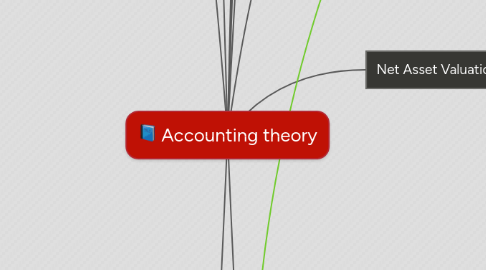
1. GDP Topics
1.1. Accounting theories
1.2. Agency theory
1.3. Allocation
1.4. Economic Consequences
2. Current Exit Values & Realizable Income
2.1. Exit value income
2.1.1. Yr = D + (Rn - [Rn-1])
2.1.1.1. Yr: realizable income D: periodic distribution of Y Rn: closing capital on exit price basis
2.1.2. Critical issues
2.1.2.1. What selling price should b used?
2.1.2.1.1. Assumed liquidation of whole entity
2.1.2.1.2. Assumption of orderly liquidation (general view)
2.1.2.2. What state shud realizable values focus on?
2.1.2.2.1. Existing state
2.1.2.2.2. Finished state adjusted for future costs
2.1.3. Based on economic concept f opportunity cost
2.1.3.1. What it could acquire with cash IF it would have realized its existing resources
2.1.4. Arguments in support of Exit Value
2.1.4.1. Realizable values are measures of current sacrifices & alternatives choices
2.1.4.2. Emphasizes a vital economic decision, opportunity costs
2.1.4.3. Comparable data is required
2.1.4.3.1. Entry value reflects "value to owner" only
2.1.4.4. Entry values claimed to be invalid
2.1.4.4.1. Don't reflect info on alternative choices
2.1.4.4.2. RC reflects a static or holding positions
2.1.4.4.3. Sterling argues that entry value model is based on the invalid & unnecessary assumption of "going concern"
2.1.4.5. Exit values are understandable
2.1.4.5.1. Commonly interpreted as market values
2.1.4.6. Evidence of use of realizable values in practice
2.1.4.6.1. Chambers argues that we already use exit values in many current situations
2.1.5. Concept of Realizable income
2.1.5.1. Yr = RG + UG
2.1.5.1.1. Comprised 2 components in terms of exit values
2.1.5.2. Yr recognizes unrealized value changes in the period they arise
2.1.5.2.1. Thus doesn't include realized gains of previous period
2.1.5.3. Holding gains as realizable income
2.1.5.3.1. Capital in exit value model is an expression of the entity's overall command over gds & svcs
2.1.5.3.2. No intention to maintain PC
2.1.5.4. Case against Realizable Income
2.1.5.4.1. Does not pay attention to operational effectiveness of entity
2.1.5.4.2. Doesn't differentiate btwn those gains which are within control of mgmt
2.1.5.4.3. Apparent assumption of liquidation of entity's resources
2.2. CoCoA model (Chambers)
2.2.1. Scale: CD & ND
2.2.2. CM: FC in terms of PP
2.2.3. Attribute: qty of A & L in terms of selling price or NRV, Current Cash Equivalent (CCE) or command over cash
2.2.4. Objective: provide firm with adaptive capacity in a world of competing alternatives
2.2.5. I/S format Sales Less: CoGS GP Inventory price change Adjusted GP Adjustments: Change in NRV of assets Less operating expenses CM adjustment Profit
2.2.5.1. B/S features
2.2.5.1.1. CCE is a calculated for A&L
2.2.5.1.2. Assets must be separable (otherwise zero value)
2.2.5.1.3. Ct1 reflects a GPL adjustment
2.2.5.1.4. Note that if assets do not have a readily available market price, they are assumed to have a ZERO VALUE even though the asset may still be in use or be usable (VIU concept)
2.2.6. Contribution of model
2.2.6.1. Shows liquid position of firms in terms of a basket of cash
2.2.6.2. Gives relevant infor for
2.2.6.2.1. Making future decisions
2.2.6.2.2. Assessing present position of the firm
2.2.6.2.3. Evaluating firms past position
2.2.6.3. Model is allocation free
2.2.6.4. No additivity prob
2.2.6.4.1. Eliminates timing problem & measurement error
2.2.6.5. Basis for contemporary "mark-to-market" rule
2.2.6.6. Emphasizes a BS in terms of adaptive capital which means NRV
2.2.6.6.1. If environment changes, then firm must liquidate and replace with new assets to survive
2.2.6.7. No distinction made btwn operating and holding activities
2.2.6.8. No distinction btwn realized and unrealized profits
2.2.6.9. Periodic profits shud include net effect of GPL changes
2.2.7. Limitations
2.2.7.1. Based on a liquidation concept
2.2.7.2. Absence of markets vs assets in use
2.2.7.3. Aggregation problem (BS)
2.2.7.4. Problems interpreting BS
2.2.7.5. NRV don't predict future earnings
2.2.8. Criticisms
2.2.8.1. A new and too radical system
2.2.8.2. Subjectivity is hnacceptable
2.2.8.3. Value and use are completely ignored meaning FA can exist with zero value
2.2.8.4. E&B rejected NRV becoz it abandons going concern assumption
2.2.8.5. Sterling rejected Business income becoz it didn't reflect sacrifices ( opportunity cost)
3. Current Cost Accounting
3.1. Additional concepts used in CCA model
3.1.1. Uses mixed values
3.1.1.1. Value to the business
3.1.1.2. Deprivation value (RC) accounting
3.1.2. Major premises underlying: assets held for use or for resales
3.1.3. Multiple values approach
3.1.3.1. Each decision requires diff valuation
3.1.3.1.1. Upper limit to an asset's value is RC(deprival value)
3.1.3.2. Possible 3 valuation bases
3.1.3.2.1. RC, PV, NRV
3.1.3.2.2. Thus, 6 combinations are feasible
3.2. General requirements of CCA
3.2.1. Limited to very large firms classified by
3.2.1.1. Inventories and FA
3.2.1.2. Total assets after depreciation
3.2.2. Considered supplementary and not subject to audit
3.2.3. 5 key features
3.2.3.1. 1. Disclosure focused on GPP & CC data
3.2.3.1.1. CD info
3.2.3.1.2. Current cost info
3.2.3.2. 2. Value to biz
3.2.3.3. 3. Adj made to obtain income from continuing operations on a current cost basis
3.2.3.3.1. COGS adj
3.2.3.3.2. Dep adj
3.2.3.3.3. No monetary WC adj
3.2.3.3.4. No gearing adj
3.2.3.4. 4. No BS was required
3.2.3.5. 5. Dual concept of CM (FC & PC)
3.3. Evaluation
3.3.1. Ambiguous valuation rule which is contradictory
3.3.1.1. Concerned with use of value data for decisions abt buying, selling, and holding yet model measures past results
3.3.2. Deprival value is hypothetical
3.3.2.1. Entity assumed to be deprived of assets, but what abt people who want info from an on-going entity
3.3.3. Mixture of asset values and the additivity prob in computing CV income
3.3.4. Do firms adapt instantaneously to MP?
3.3.5. Individual purposes seem to be satisfied but what about overall utility?
3.3.5.1. No segregation of operating profits from HG
3.3.5.2. Does contribute to CV BS
3.3.5.3. Can be implemented to multiuser groups in practice
3.4. Dismissal of CCA
3.4.1. INFO useless, HC adequate
3.4.2. Info useful, but users inadequate
3.4.3. Info useful, but measurements inadequate
3.4.4. Info wld b useful, but wrong info disclosed
3.4.5. Info is useful, but empirical models are inadequate
4. System approach to accounting
4.1. Inputs
4.1.1. Measured elements of transactions
4.2. Throughput (method process)
4.2.1. Operations: the program classifying, selecting, matching
4.3. Outputs
4.3.1. Financial statements (disclosures)
5. Capital Maintenance
5.1. Amount of dollars that can be distributed as income without impairing capital
5.1.1. Determines total income
5.2. 2 major issues
5.2.1. 1. Preserve capital
5.2.2. 2. Distribute income
5.3. Types
5.3.1. Financial Capital
5.3.1.1. Can distribute BUSINESS INCOME (COP+RHG+UHG) and still maintain capital
5.3.2. Physical Maintenance
5.3.2.1. Can only distribute TRADING GAINS (COP)
5.4. Net Asset = C + RE
5.5. Impact on changing prices
5.5.1. General Price Index (Inflation)
5.5.1.1. Constant Dollar
5.5.1.1.1. Approach
5.5.1.1.2. Evaluaton
5.5.1.1.3. Criticism
5.5.1.2. Eg CPI
5.5.1.2.1. frequency and timeliness
5.5.2. Specific Price Index
5.5.2.1. Buying market
5.5.2.1.1. Input prices
5.5.2.2. Selling market
5.5.2.2.1. Historical entry price
5.5.2.2.2. Trading gain Realized cost change/ HG Unrealized cost change
5.5.2.2.3. Realized exit price
5.5.2.3. Measure in terms of operating capacity
5.5.2.3.1. Physical capital maintenance
5.6. What does CM Rule do?
5.6.1. 1. Determines lifetime income
5.6.2. 2. Defines measure of capital & measure of income
5.6.3. 3. Determines composition of OE Section of BS
5.6.3.1. Restates beg & earned capital balances into end of period units
5.6.3.2. Excess ending capital above the restated original capital is an increment income to earned capital
5.6.4. 4. Allocates increment btwn
5.6.4.1. Adjustment of opening capital
5.6.4.2. Income for the period
5.6.5. 5. Differentiates return on capital from return of capital
5.7. Comments
5.7.1. Timing problems
5.7.1.1. Entry Price (RC)
6. Measurement
6.1. Nominal Dollars
6.2. Constant Dollars
7. Accounting models
7.1. HC
7.1.1. Exchanges
7.1.1.1. Reciprocal flows of services
7.1.2. Dr = Cr
7.1.3. Yesterday
7.1.3.1. Verifiable, objective evidence
7.1.4. Fundamentals
7.1.4.1. 3 elements mandatory
7.1.4.1.1. Date set
7.1.4.1.2. Measure
7.1.4.1.3. Concept of entity
7.1.4.2. Systems approach
7.1.4.2.1. Services (flow concept)
7.2. CV
7.2.1. Elements of wealth
7.2.1.1. Sum of PnQn
7.2.2. Today
7.2.3. Entry Value
7.2.3.1. Replacement Cost
7.2.3.1.1. Based on hypothetical transaction
7.2.4. Exit Value
7.2.4.1. Net Realizable Value
7.2.4.1.1. FV accounting
7.2.5. Fundementals
7.2.5.1. Systems approach
7.2.5.1.1. Scare resources (stock concept)
7.3. PV
7.3.1. Expected CF
7.3.1.1. NPV
7.3.2. Tomorrow
7.3.3. Fundementals
7.3.3.1. Systems approach
7.3.3.1.1. Expected cash flows (stock concept)
8. Summary of CM & NAV
8.1. CM determines the adj factor for items which differ in timing
8.2. CM necessary & sufficient for calculating lifetime income
8.3. But CM not sufficient for calculating periodic income
8.4. Valuation of paid-in capital depends on CM rule
8.5. NAV rule determines amt and timing of HG/L
8.5.1. Explicitly governs A&L effects in IS
8.6. CM Concept determines extent to which these HG & HL avail for distribution
8.7. RE affected by both CM and NAV rules
8.7.1. Together determines periodic Y
9. Net Asset Valuation
9.1. Types
9.1.1. Straight line method
9.1.2. Economic income
9.1.2.1. Certainty
9.1.2.1.1. Capital is a prerequisite to determining income
9.1.2.2. Uncertainty
9.2. What does NAV Rule do?
9.2.1. Determines total amt of OE section
9.2.1.1. Measure assets and liabilities at a specific point in time
9.2.1.2. Determines timing of income recognition
9.2.1.3. Allocates lifetime income to accounting periods
10. Current Entry Values
10.1. Edwards & Bell Model
10.1.1. Focus is to evaluate past decisions of managers and efficiency of firm
10.1.1.1. Operational decisions (pt of recognition)
10.1.1.2. Holding decisions & pre-recognition of values changes over time (b4 pt of recognition)
10.1.1.3. Eg, COP, PCM, measure of managers ¬ firm, unrealized income out of carol of managers Business income, measure of firm specific price changes
10.1.2. Entry value income
10.1.2.1. Reflect value added to resources
10.1.2.2. Reflect an adjustment to capital for CM
10.1.3. 3 types of holding gains based on types of resources
10.1.3.1. 1. Inventory HG
10.1.3.1.1. RHG
10.1.3.1.2. UHG in replacement cost of RM, WIP, FG
10.1.3.2. 2. Fixed Assets cost savings
10.1.3.2.1. RHG & UHG in RC of DEPRECIATED FA
10.1.3.3. 3. capital gains
10.1.3.3.1. RHG & UHG in RC of UNDEPRECIATED FA
10.1.4. Concept of Business Income
10.1.4.1. Accounting income HC (NI)
10.1.4.1.1. Ya = COP + RHG' + RHG
10.1.4.1.2. However, COP is measured in terms of PCM
10.1.4.2. Business income
10.1.4.2.1. Yb = COP + RHG + UHG
10.1.4.3. Once all gains are realized, Ya = Yb
10.1.4.3.1. Ya = Yb
10.1.4.4. FCM vs PCM
10.1.4.4.1. Concerns how much can be distributable income
10.1.4.5. Real business profit
10.1.4.5.1. Scale : CD
10.1.4.5.2. CM concept: current entry value in terms of PP
10.1.4.5.3. Example
10.1.4.6. RC model
10.1.4.6.1. Advantages of RC
10.1.4.6.2. Disadvantages of RC
10.1.4.6.3. Are HG income?