


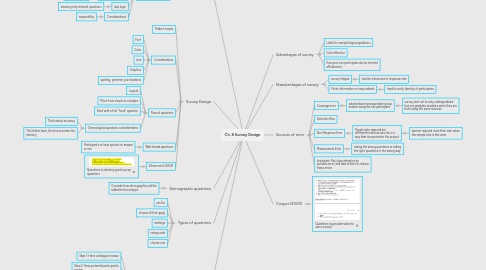
1. Delivery Methods
1.1. How data is collected?
1.1.1. Technology
1.1.2. Paper based
1.1.2.1. good response rate of near 100%
1.1.3. Branching questions
1.1.3.1. Need to be clear
1.1.4. skip logic
1.1.4.1. showing only relevant questions
1.1.5. Considerations
1.1.5.1. assessibility
2. Survey Design
2.1. Make it simple
2.2. Considerations
2.2.1. Font
2.2.2. Color
2.2.3. size
2.2.4. Graphics
2.2.5. spelling, grammar, punctuations
2.3. Flow of questions
2.3.1. Logical
2.3.2. Move from simple to complex
2.3.3. Start with a first "hook" question
2.3.4. Chronological questions considerations
2.3.4.1. Think about accuracy
2.3.4.2. The farther back, the less accurate the memory
2.4. Web-based questions
2.4.1. Participants to have options to answer or not.
2.5. Dilman et al (2009)
2.5.1. Questions to develop good survey questions
3. Demographic questions
3.1. Consider how demographics will be added to the analysis
4. Types of questions
4.1. yes/no
4.2. choose all that apply
4.3. rankings
4.4. rating scale
4.5. choose one
5. Pilot Testing
5.1. Dillman (2007) describes four steps
5.1.1. Step 1: Have colleagues review
5.1.2. Step 2: Have potential participants review
5.1.3. Step 3: Conduct a small pilot study
5.1.4. Step 4: Conduct one more review just to make sure nothing is missed
6. Advantages of survey
6.1. Useful to sample large populations
6.2. Cost effective
6.3. Everyone can participate due to internet affordances
7. Disadvantages of survey
7.1. survey fatigue
7.1.1. lead to a decrease in response rate
7.2. Finite information on respondants
7.2.1. hard to verify identity of participants
8. Sources of error
8.1. Coverage error
8.1.1. selected wrong respondant group andnot everyone can participate
8.1.1.1. survey sent out to only undergraduate but not graduate students when they are both using the same services
8.2. Selection Bias
8.3. Non Response Error
8.3.1. People who respond are differentfromthose who do in a way that isimportantto the project
8.3.1.1. women respond more than men when the sample size is the same
8.4. Measurement Error
8.4.1. asking the wrong questions or asking the right questions in the wrong way