


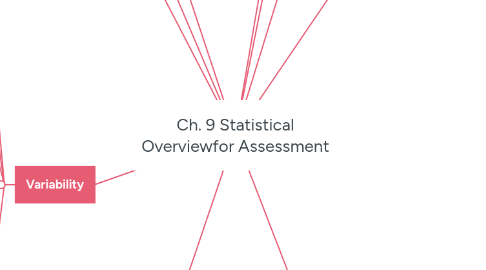
1. Descriptive Statistics
1.1. techniques to organize and summarize data
1.2. Frequencies
1.3. Measures of central tendency
2. Inferential Statistics
2.1. Uses probabilities and information about a sample to draw conclusions about a population
3. Frequencies
3.1. used to describe data
4. Variability
4.1. What?
4.1.1. describes the dispersion of scores about the mean score or other measure of central tendency
4.1.2. used to examine the extent which the scores are similar or varied
4.2. Range
4.2.1. the distance between the smallest and largest
4.2.2. highest score - lowest score = range score
4.3. Variance
4.3.1. provides a statistical average of the amount of dispersion in a distribution of scores
4.4. Standard Deviation
4.4.1. the square root of the variance
4.4.2. the measure of the extent to which scores are distributed around the mean (M)
4.4.3. small deviation
4.4.3.1. scores are tightly clustered around the M
4.5. Correlation
4.5.1. to understand what happens to one variable when one varies in some way
4.5.2. describes the relationship between variables
4.5.3. correlation coefficient, "r"
4.5.3.1. is the number representing the linear relationship between two variables
4.5.3.2. when positive (direct)
4.5.3.2.1. correlation is the same direction
4.5.3.3. when negative (indirect)
4.5.3.3.1. correlation in opposite direction
4.5.3.4. the closer to 1 or -1
4.5.3.4.1. the stronger the correlation
5. Confidence Interval
5.1. Margin of Error
5.1.1. provides the range within which thepopulation mean is likely to occur
5.2. information about how similar the sample mean is to the population mean
5.3. how confident are we about the sample?
6. Purpose
6.1. Help student affairs practitioners better understand students and their needs, challenge assumptions, and provide evidence about needs, processes and outcomes
7. Levels of Data
7.1. Nominal
7.1.1. Categorial
7.1.1.1. Ex: race/ethnicity
7.2. Continuous data
7.2.1. Ratio
7.2.2. Interval
7.2.3. Ordinal
7.2.3.1. Measured on a scale
7.2.3.1.1. Ex: Likert scale
8. Measures of Central Tendency
8.1. Mean
8.1.1. average of a set of scores
8.1.1.1. represented by "M"
8.1.2. takes into account every score
8.2. Median
8.2.1. the middle number in a list of numbers
8.2.2. can be a stable measure of central tendency
8.2.3. if odd, the middle number is the median
8.2.4. if even, add two of the middle numbers and average
8.2.5. Ex: measuring household income
8.2.5.1. if we use M, the data can be distorted with people with high level income
8.3. Mode
8.3.1. the most frequent score in a distribution
8.3.2. Purpose:
8.3.2.1. to highlight common scores or for a nominal data
9. Inferential Statistics
9.1. Uses probabilities and information about a sample to draw conclusions about a population
9.2. Population
9.2.1. N
9.2.1.1. is the entire group
9.3. Sample
9.3.1. n
9.3.1.1. a subset of the population whose data is gathered
10. Types of Sampling
10.1. Random
10.1.1. Simple Random Sampling
10.1.2. Stratified Random Sampling
10.1.3. Cluster Sampling
10.1.4. Multistage Cluster Sampling
10.2. Non Random
10.2.1. Systematic Sampling
10.2.2. Convenience Sampling
10.2.3. Purposive Sampling
10.2.4. Snowball Sampling
10.3. Sample Size and Response rate
10.3.1. representation and power
10.3.2. power
10.3.2.1. the size of the data gets larger
10.3.2.2. a probability when a statistical test found an effect
10.3.2.3. better to have larger sample to get statistical difference
10.3.2.4. boost the statistical test
10.4. Parametric tests
10.4.1. make assumptions about the nature of the population
10.4.1.1. continuous variable
10.4.2. t-Tests
10.4.2.1. compare the means between two groups to see if they are statistically significant
10.4.2.2. uses p value
10.4.2.3. Cohen's d
10.4.2.4. compare height between 4 year old and 5 year old
10.4.3. t-Tests for Proportions
10.4.3.1. analyze the difference between two proportions
10.4.4. ANOVA
10.4.4.1. measured difference between means in three or more groups
10.4.4.2. compare GPA between junior, freshmen, senior.
10.5. Non parametric tests
10.5.1. Mann-Whitney U Test
10.5.1.1. used to analyze ranked data
10.5.2. Chi Square Tests
10.5.2.1. analyzes the differences between data in categories
10.5.2.1.1. gender differences
10.5.3. Wilcoxon Ranked Test
10.5.3.1. determine if two groups are statisticalluy significant from each other
10.5.4. Kruskal Wallis One Way Analysis of Variance
10.5.4.1. ANOVA for non parametric tests
10.5.5. categorical variable