


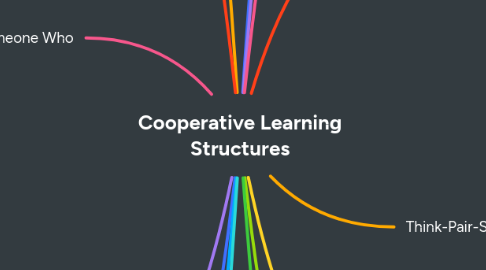
1. Mix-Freeze-Share
1.1. 1. Ss walk around the classroom
1.1.1. Notes: Students cannot walk with their friends, you can reorganize the classroom if needed, tell them to be mindful of others personal spaces
1.2. 2. Ss stop walking when the music stops
1.2.1. Choose music Ss enjoy
1.3. 3. Ss pair up with the closest person
1.3.1. Again, not their friends
1.4. 4. Ss talk about the topic w/ their partner
1.4.1. Introduce students to a dialogue, either by writing or modeling it
1.5. 5. Ss wait for the signal and start walking around the classroom again
2. Mix-Pair-Share
2.1. 1. Ss mix around the room.
2.2. 2. Teacher calls <Pair>.
2.3. 3. Ss must pair w/ the person closest to them and give them a high five. Ss who have not found a partner raise their hands to find each other
2.4. 4. T asks a q and gives think time
2.5. 5. Ss share with their partners using: Timed Pair Share or Rally Robin
3. Find Someone Who
3.1. 1. Ss mix in the class, keeping a hand raisued until they find a partner that is not a teammate
3.2. 2. In pairs, Partner A asks a q from the worksheet; Partner B responds. Partner A records the answer on his or her own worksheet and expresses appreciation
3.3. 3. Partner B checks and initials the answer
3.4. 4. Partner B asks a q; Partner A responds. Partner B records the answer on his or her own worksheet and expresses appreciation.
3.5. 5. Partner A checks and initials the answer
3.6. 6. Partners shake hands, [art, and raise a hand as they search for a new partner
3.7. 7. Ss repeat Steps 1-6 until their worksheets are complete.
3.8. 8. When their worksheets are complete, Ss sit; seated Ss may be approached by others as a resource
3.9. 9. In teams, Ss compare answers; if there is disagreement or uncertainty, they raise four hands to ask a team q
4. Three-Step-Interview
4.1. 1. T provides interview topic, states the duration of the interview, and provides think time
4.2. 2. Student A interviews student B
4.2.1. Add a timer
4.3. 3. Student B interviews student A
4.4. 4. Ss A and B meet Ss C and D to talk about their interviews
4.4.1. They each talk about their partners
5. Crossword Puzzle Jigsaw
5.1. 1. Each teammember has a clue.
5.2. 2. Ss must work in groups or pairs to assemble the clues to solve the questions.
6. Within Teams Jigsaw
6.1. 1. Students form a <Base Team> are they become experts on a given subject.
6.2. 2. Ss enter <Expert Teams> and teach the expert content.
6.3. 3. Ss return to their <Base Teams>.
6.4. 4. The process is repeated until each expert topic is covered.
7. Talking Chips
7.1. 1. T provides a discussion topic and provides think time.
7.2. 2. Any student begins the discussion, placing one of their chips in the center of the table.
7.3. 3. Any student w/ a chip continues discussing, using their chip.
7.4. 4. When all chips are used, teammates collect their chips and continue the discussion using their talking chips.
8. Round Robin
8.1. 1. T poses a problem to which there are multiple possible responses or solutions, and provides think time
8.2. 2. Ss take turns stating responses or solutions
9. Round Table
9.1. 1. T provides a task to which there are multiple possible responses, and provides think time
9.2. Ss take turns passing a paper and pencil or a team project, each writing one answer or making a contribution
10. Heads Together
10.1. Mini-Dialogue
10.1.1. 1. T asks a q. or shows a picture. He announces a Heads Together discussion.
10.1.2. 2. Ss discuss and help each other
10.1.3. 3. T stops the discussion (Hands up!)
10.1.4. 4. T elicits answers from a student
11. Inside Outside Circle
11.1. 1. Ss form pairs. One student from each pair moves to form one large circle in the class facing outward.
11.2. 2. Remaining Ss find and face their partners (class now stands in two concentric circles)
11.3. 3. Inside circle Ss ask a q from heir q card; outside circle Ss answer. Inside circle Ss praise or coach.
11.3.1. Alternative - The teacher asks a q and indicates inside or outside student to answer to their partner
11.4. 4. Partners switch roles. Outside circle Ss ask, listen, then praise or coach.
11.5. Partners trade q cards.
11.6. Inside circle Ss rotate clockwise to a new partner
11.6.1. Teacher may call rotation numbers: <Rotate Three Ahead>, lead by a choral count.
12. Think-Pair-Share
12.1. During the think part, students think or answer a question on their own (students will work individually)
12.2. During the pair part, students discuss their answers with a partner
12.2.1. The teacher tells us what dialogue to use and writes it on the board
12.3. During the share part, students discuss their partners answer with the group
13. Pairs Jigsaw
13.1. 1. Divide class in half and give each half a material to master
13.1.1. Ex., A math proble, a story, or a histor event to read and analyze