


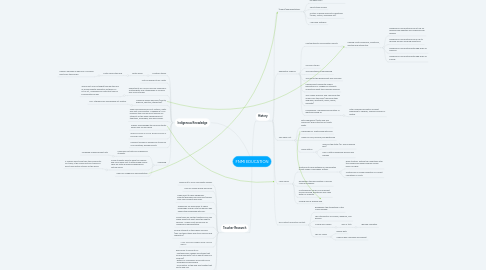
1. Teacher Research
1.1. Reach out to local community leaders
1.2. Look for school board resources
1.3. Make effort to help Indigenous parents/guardians feel welcome/valued. They can be great resources.
1.4. Always ask for permission to share knowledge. Always cite the person who shared the knowledge with you.
1.5. Know there are certain traditions you can speak about but don't have the right to perform. *These must be done by an Indigenous representative.
1.6. Include students in the inquiry process. (This can teach them how to be curious and respectful.)
1.7. “I AM NOT AN EXPERT AND THAT’S OKAY"
1.8. Resources to look out for: -contemporary images and stories that include humanity (not all about trauma or violence) -history of colonialism from both POVs -language and worldview -local history of the land and treaties that led to land use
1.9. Agents of change, not victims!
2. Indigenous Knowledge
2.1. Creation stories
2.1.1. Turtle Island
2.1.1.1. Turtle carries the land
2.1.1.1.1. Harper's apology in which all of Canada must carry the burden
2.2. Not be referred to as "myth"
2.3. Opportunity for cross-curricular learning of Sustainability and Stewardship in Science and Social Studies
2.3.1. Should not only be taught through the lens of environmental education as there is a lot of Art, Language and Math that can be incorporated as well
2.4. Medicine Wheel approach (mental, physical, spiritual, intellectual)
2.4.1. OCT Standards as Anishinaabe Art Posters
2.5. There are hundreds of First Nations, Metis and Inuit communities. "Indigenous" is an umbrella term and we must remind our students of this when speaking about traditions, languages, and world-views
2.6. Always acknowledge the land and treaty where you live and work
2.7. “EVERYTHING IS ALIVE. EVERYTHING IS CONNECTED"
2.8. Different modes of passing on stories ex. oral narratives, wampum belts
2.9. Schooling
2.9.1. High drop out rates for Indigenous students
2.9.1.1. Increased unemployment rate
2.9.2. Some students have to leave the reserve and move away just to attend high school. They are often bullied and experience culture shock
2.9.2.1. If schools aren't safe than the community isn't safe, if the community isn't safe you won't have active citizens of the world
2.9.3. Need for Indigenous representation
3. History
3.1. (Media) Representations
3.1.1. Pocahontas narrative of leaving her culture/land for the white man (written by white men)
3.1.2. Sports team names
3.1.3. History of being incorrectly identified (Indian, Native, Aborignial etc)
3.1.4. "Tipis and feathers"
3.2. Residential Schools
3.2.1. Contributing to reconciliation efforts
3.2.1.1. Healing must be physical, emotional, spiritual and intellectual
3.2.1.1.1. Indigenous communities more at risk for diseases like diabetes and cardiovascular disease
3.2.1.1.2. Indigenous communities more a risk to develop alcohol and drug addictions
3.2.1.1.3. Indigenous communities with high levels of violence
3.2.1.1.4. Indigenous communities with high levels of suicide
3.2.2. Survivor Stories
3.2.3. The importance of apologizing
3.2.4. The role of the government and churches
3.2.5. Helping post-residential school generations of Indigenous students understand what their families endured
3.2.6. The "Indian problem" and "removing the Indian from the child" (removing their language, spirituality, home, family, sexuality)
3.2.7. Propaganda- misleading information of what was going on
3.2.7.1. Later missing information of what happened to children, falsified records of deaths
3.3. The Indian Act
3.3.1. Both oppressive (limits land and resources) and protective of treaty rights
3.3.2. Ownership vs. relationship with land
3.3.3. Need for food, housing, and healthcare
3.3.4. Indian status
3.3.4.1. "Ward of the state" (Dr. Dion's hearing aids)
3.3.4.2. Loss of status especially women and children
3.4. Land claims
3.4.1. Treaties not being withheld or manipulated to suit needs of European settlers
3.4.1.1. Blank treaties- writing the conditions after the Indigenous leaders signed a blank piece of paper
3.4.1.2. Treaties are no longer reflective of current conditions or costs
3.4.2. Breakdown the feminization of land as "free for pillaging"
3.4.3. Contemporary issues of insufficient access housing, healthcare and clean water on reserves
3.4.4. Ceding versus sharing land
3.5. Pre-contact and initial contact
3.5.1. Breakdown the stereotype of the "noble savage"
3.5.2. The introduction of alcohol, weapons, and disease
3.5.3. "Friend and Helper"
3.5.3.1. War of 1812
3.5.3.1.1. ignored casualties
3.5.4. The Fur Trade
3.5.4.1. Beaver hats
3.5.4.2. Hudson Bay Company and blanket