


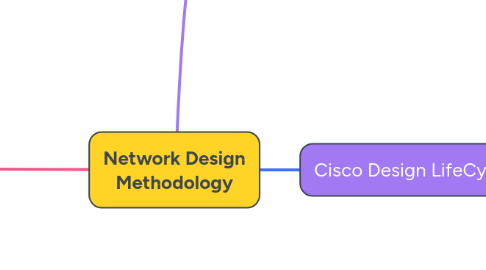
1. Cisco Design LifeCycle
1.1. Phases
1.1.1. Plan Phase
1.1.1.1. Strategy & Analays
1.1.1.1.1. Network Architucture & RoadMap
1.1.1.2. Assessment
1.1.1.2.1. Determine gaps and Current State
1.1.1.3. Design
1.1.1.3.1. Scalable Design
1.1.2. Build Phase
1.1.2.1. Validation
1.1.2.1.1. Solution Must Meets Requirements
1.1.2.2. Deployment
1.1.2.2.1. Installing new IT & Network Solution
1.1.2.3. Migration
1.1.2.3.1. Upgrading Infrastrusture & Reduce Cost
1.1.3. Manage Phase
1.1.3.1. Product Support Proccess
1.1.3.1.1. Automation Do the Normal Work
1.1.3.2. Proccess Support Product
1.1.3.2.1. Dedicated Resources & Focus to Make Complex Solutions
1.1.3.3. Optimization
1.1.3.3.1. Identify Gaps with Solution And Recommendation
1.1.3.4. Opreation Management
1.1.3.4.1. Ensure That Network Staff has Competence
2. Steps
2.1. 2- Characterizing the Existing Network
2.1.1. Identify Major Features & Tools to Analayze + Tools for Auditing
2.1.2. Steps For Information Gathering
2.1.2.1. 2- Perform Netwok Audit
2.1.2.1.1. Audit Provide
2.1.2.1.2. Audit Tools
2.1.2.2. 1- Identify Properties of the Existing Network
2.1.2.3. 3- Analyze the Gathered Information
2.2. 1- Identifiying Costumer Network Requirement
2.2.1. Identify Network Applications
2.2.2. Define Organization Goals
2.2.3. Define Organization Constraints
2.2.4. Define Technical Goals
2.2.5. Define Technical Constraints
2.2.6. Diagram
2.3. 3- Designing the Network Topology & Solutions
2.3.1. Top-Down Approach
2.3.1.1. Starting from Top Layer of OSI
2.3.1.2. Adapts Physical Infrastructure & Network Requirements
2.3.1.3. Steps
2.3.1.3.1. 1- Analysis of Application & Organization Requirements
2.3.1.3.2. 2- Starts from Top OSI Model
2.3.1.3.3. 3- Gather Additional Data
2.3.2. Approach Compare
2.3.2.1. Top-Down
2.3.2.1.1. Benefits
2.3.2.1.2. DisAdvantages
2.3.2.2. Bottom-Up
2.3.2.2.1. Benefits
2.3.2.2.2. DisAdvantages
3. PPDIOO
3.1. Prepare
3.1.1. Establish Business Requirements
3.2. Plan
3.2.1. Identifies Network Requirements
3.3. Design
3.3.1. Provides High Reliability , Security & Performance
3.4. Implemnt
3.4.1. Installation of New Equipment
3.5. Operate
3.5.1. Day-To-Day Network Operations
3.6. Optimize
3.6.1. Proactive Network Management to Design