1.1. Skimming is a quick reading technique to grasp the main idea or important information from a text without having to read each word in detail. When skimming, readers often focus on parts such as the title, subheadings, opening paragraphs and conclusion to understand the general content of the text. This technique is useful for quickly determining whether a document is relevant and whether it should be read more closely.
1.2. Skimming is a quick reading technique to grasp the main idea of a text without having to read every word in detail. When using skimming, readers often pay attention to the title, subheadings, first and last sentences of the paragraph, as well as important keywords to get an overview of the content. This technique is useful for quickly identifying essential information or reviewing the content of a document without having to read it in its entirety.
1.3. Skimming skills are useful in the following situations: 1. **Search information quickly**: When you need to determine whether a text or document contains necessary information. 2. **Review and review**: When you need to review content or review material to find key points without reading the entire text. 3. **Time Management**: When you have to process a large amount of information and need to decide quickly about the importance of each section. 4. **Reading unfamiliar material**: When you encounter new or unfamiliar material and want to quickly understand the general content before reading more carefully. 5. **Learn the content before reading in detail**: When you want to get an overview before deciding whether to invest time to read more carefully.
1.4. The steps in skimming usually include: 1. Read the title and subheadings: Look through the title and subheadings to understand the main content and structure of the text. 2. Look at the beginning and ending paragraphs: Read the first and last sentences of each paragraph, because often these sentences contain important information or the main idea of the paragraph. 3. Search for important keywords and phrases: Find important keywords, phrases or highlighted parts such as bold, underlined to quickly grasp the main content. 4. See other highlights: Pay attention to other elements such as tables, charts, lists, or highlighted sections. 5. Quickly read through the middle sentences: Skim through the middle sentences to find more detailed information if needed.
2. SCANNING
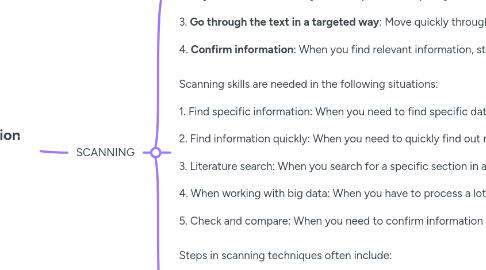
2.1. Scanning is a reading technique aimed at finding specific information in a text. When using scanning, you read through text quickly to locate and search for the specific data or keywords you need, without having to read the entire content. **Steps in scanning usually include:** 1. **Identify the information you are looking for**: Clearly identify the specific information or data you are looking for, such as numbers, names, dates, or keywords. 2. **Keyword Search**: Use keywords or phrases to quickly search within text. You can scan to spot related words or phrases. 3. **Go through the text in a targeted way**: Move quickly through the text, focusing on the sections that are likely to contain the information you need. Pay attention to standout elements like titles, listings, or keywords. 4. **Confirm information**: When you find relevant information, stop and read it carefully to confirm that it is accurate and relevant to your requirements.
2.2. Scanning skills are needed in the following situations: 1. Find specific information: When you need to find specific data or details in a text, such as a phone number, address, date, or name. 2. Find information quickly: When you need to quickly find out necessary information from a long document without reading the entire text. 3. Literature search: When you search for a specific section in a book, newspaper, or research report where you know in advance what information you are looking for. 4. When working with big data: When you have to process a lot of documents or data and need to find a specific target among hundreds or thousands of items. 5. Check and compare: When you need to confirm information already in a document, such as when checking figures or comparing data between different sources.
2.3. Steps in scanning techniques often include: 1. Identify the information you need to find: Clearly identify the specific information or data you need to search for, such as numbers, names, dates, or keywords. 2. Find related keywords and phrases: Identify keywords or phrases related to the information you need. This helps guide the search process. 3. Browse text quickly: Move quickly through text, focusing on sections that are likely to contain essential information, such as headings, lists, or featured paragraphs. 4. Use search tools (if available): If you work with electronic documents, use the software's search function to quickly find the necessary information. 5. Confirm information: When you find relevant information, stop to read it carefully and confirm that it is correct and meets your requirements.
3. PARAPHRASING
3.1. Paraphrasing is the process of restating ideas or information from an original source using different words and sentence structures. The purpose of paraphrasing is to clarify or explain information in your own way without changing the original meaning. The steps in paraphrasing typically include: 1. Read and understand the original information: Make sure you clearly understand the content and meaning of the paragraph or sentence that needs to be interpreted. 2. Identify main ideas: Identify main ideas and important information in the original text. 3. Rephrase in your own words: Use different words and sentence structures to restate the idea, keeping the same meaning but changing the expression. 4. Compare with the original text: Compare the paraphrase with the original text to ensure the meaning is not changed and words are not copied too much. 5. Check grammar and clarity: Make sure your paraphrase is clear, precise, and free of grammatical errors.
3.2. This technique includes the following: a. Use synonyms b. Use antonyms c. Change from a specific noun d. Change from a common noun to a specific noun e. Change from type f. Use other structures
3.3. 4. BASIC QUESTION TYPES IN READING COMPREHENSION EXERCISES A - MAIN IDEA QUESTIONS B - SPECIFIC INFORMATION & INFERENCE QUESTIONS