


My New Mind Map
af Angelina “Savannah Hawk” Cameron
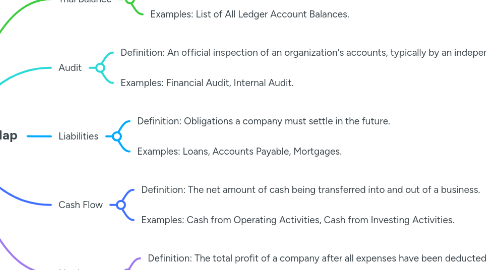
1. Accounts Payable: Short-term obligations to be paid by an organization.
2. Accounts Receivable: Money owed to a company by its debtors.
3. Balance Sheet: A financial statement that reports a company's assets, liabilities, and equity at a specific point in time.
4. Current Assets: Assets that can be converted into cash within one year.
5. Equity: The residual interest in the assets of an entity after deducting liabilities.
6. Expenses: The cost of goods or services used to operate a business.
7. Fixed Assets: Long-term assets that are not expected to be converted into cash within one year
8. Trial Balance
8.1. Definition: A bookkeeping worksheet in which the balances of all ledgers are compiled into debit and credit account columns.
8.2. Examples: List of All Ledger Account Balances.
9. Audit
9.1. Definition: An official inspection of an organization's accounts, typically by an independent body.
9.2. Examples: Financial Audit, Internal Audit.
10. Liabilities
10.1. Definition: Obligations a company must settle in the future.
10.2. Examples: Loans, Accounts Payable, Mortgages.
11. Cash Flow
11.1. Definition: The net amount of cash being transferred into and out of a business.
11.2. Examples: Cash from Operating Activities, Cash from Investing Activities.
12. Net Income
12.1. Definition: The total profit of a company after all expenses have been deducted from revenue.
12.2. Examples: Total Revenue - Total Expenses.
13. Gross Profit
13.1. Definition: Revenue minus the cost of goods sold (COGS).
13.2. Examples: Sales Revenue - COGS.
14. Depreciation
14.1. Definition: The allocation of the cost of a tangible asset over its useful life.
14.2. Examples: Depreciation on Machinery, Vehicles.
15. Revenue
15.1. Definition: Income generated from normal business operations.
15.2. Examples: Sales Revenue, Service Revenue.
15.3. Sole Proprietorship: A sole proprietorship, is also known as the sole trader or simply a proprietorship, is a type of business entity that is owned and run by an individual.
15.3.1. Partnership: A business organization in which two or more individuals manage and operate the business. Both owners are equally and personally liable for the debts from the business.
15.3.2. Private Limited Company: It is a type of privately held small/medium business entity, in which owner liability is limited to their shares, the firm is limited to having 200 or fewer shareholders, and shares are prohibited from being publicly traded.