Trans-semiotizing and re-sourcing resources in language education: Towards a multimodal social semiotic perspective on intercultural communication Jose Aldemar Álvarez Valencia (2019)
af Juliethlorena Lopez
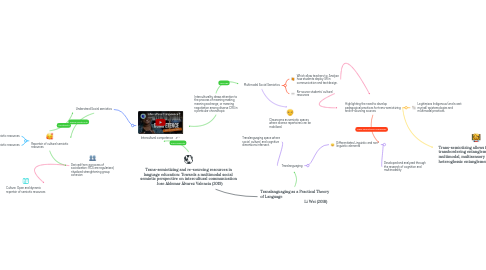
1. Translanguaging as a Practical Theory of Language Li Wei (2018)
2. Intercultural competence
2.1. Understand Social semiotics
3. Translanguaging
3.1. Differentiates Linguistic and non- linguistic elements
3.1.1. Developed and analyzed through the research of cognition and multimodality
3.2. Translanguaging space where social, cultural, and cognitive dimensions intersect.
4. Interculturality draws attention to the process of meaning making, meaning exchange, or meaning negotiation among diverse CRS in a particular chronotopic
5. Multimodal Social Semiotics
5.1. Which allow teachers to: Analyze how students deploy SR in communication and text design.
5.2. Re-source students' cultural resources
6. Highlighting the need to develop pedagogical practices for trans-semiotizing and re-sourcing sources
6.1. Legitimizes Indigenous (and a vast myriad) epistemologies and multimodal practices.
7. Classrooms as semiotic spaces where diverse repertoires can be mobilized.
8. Trans-semiotizing allows for transbordering entanglements, including: multimodal, multisensory and heteroglossic entanglements.
9. Repertoir of cultural semiotic resources
9.1. Material Semiotic resources
9.2. Non- Material Semiotic resources
10. Culture: Open and dynamic repertoir of semiotic resources
11. Derived from a process of socialization: RCS are regularized, ritualized strenghtening group cohesion


