

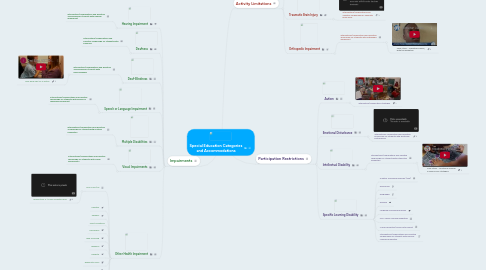
1. Impairments
1.1. Hearing Impairment
1.1.1. Interventions/Modifications and Assistive Technology for Students with Hearing Impairment
1.2. Deafness
1.2.1. Interventions/Modifications and Assistive Technology for Students with Deafness
1.3. Deaf-Blindness
1.3.1. Interventions/Modifications and Assistive Technology for Students with Deaf-Blindness
1.3.1.1. Deaf Blind ABC123 in action
1.4. Speech or Language Impairment
1.4.1. Interventions/Modifications and Assistive Technology for Students with Speech or Language Impairment
1.5. Multiple Disabilities
1.5.1. Interventions/Modifications and Assistive Technology for Students with Multiple Disabilities
1.6. Visual Impairments
1.6.1. Interventions/Modifications and Assistive Technology for Students with Visual Impairments
1.7. Other Health Impairment
1.7.1. ADD or AD/HD
1.7.1.1. Brad's Story: A 12 Year Old with ADHD
1.7.2. Diabetes
1.7.3. Epilepsy
1.7.4. Heart Conditions
1.7.5. Hemophilia
1.7.6. Lead Poisoning
1.7.7. Leukemia
1.7.8. Nephritis
1.7.9. Rheumatic Fever
1.7.10. Sickle Cell Anemia
1.7.11. Interventions/Modifications and Assistive Technology for Students with Other Health Impairment
1.7.12. Tourette Syndrome
1.7.12.1. Teaching Students with Tourette Case Study
2. Activity Limitations
2.1. Developmental Delay
2.1.1. Interventions/Modifications and Assistive Technology for Students with Developmental Delays
2.1.1.1. Assistive Technology in Action - Jared
2.2. Traumatic Brain Injury
2.2.1. Interventions/Modifications and Assistive Technology for Traumatic Brain Injury
2.3. Orthopedic Impairment
2.3.1. Interventions/Modifications and Assistive Technology for Students with Orthopedic Impairment
2.3.1.1. Case Study - Johnathan Francis, quite the exception
3. Participation Restrictions
3.1. Autism
3.1.1. Intervention/Modification Strategies
3.2. Emotional Disturbance
3.2.1. Interventions-Modifications and Assistive Technology for Students with Emotional Disturbances
3.3. Intellectual Disability
3.3.1. Interventions/Modifications and Assistive Technology for Students with Intellectual Disabilities
3.3.1.1. Case Study - Vocational Training in Ghana AAC Strategies
3.4. Specific Learning Disability
3.4.1. Auditory Processing Disorder (APD)
3.4.2. Dyscalculia
3.4.3. Dysgraphia
3.4.4. Dyslexia
3.4.5. Language Processing Disorder
3.4.6. Non-Verbal Learning Disabilities
3.4.7. Visual Perceptual/Visual Motor Deficit
3.4.8. Interventions/Modifications and Assistive Technologies for students with Specific Learning Disabilities