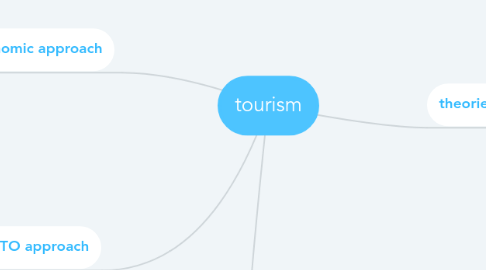
1.1. in began in the twentieth cenury tourism" is the transit of people, who are temporarily absent from their usual location to please the cultural demands or personal desires
2. socio-economic approach
2.1. second half of the twentieth century. mass tourism socio-economic phenomenon resulting from changes that emerged after the Second World War
2.2. tourism: "set of human interactions, transportation, lodging, services, and entertainment, with various purposes"
2.3. IUOTO defined tourism as: "the sum of the relationships and services resulting from a change of temporary residence and not motivated by any company or professional"
3. WTO approach
3.1. Tourism concept in 1991:
3.2. "involves the activities of people who travel and are in places outside their usual environment for more than a consecutive year in order to enjoy their free time, business or other"
4. theories
4.1. latin theory: "the activity carried out by people who are traveling and who also intend to return to their usual location"
4.2. saxon theory: it was believed then that the nobles must travel to different kingdoms to acquire knowledge that is useful when governing
4.3. aramaic theory: the term tourism is not derived from the Latin language but from ancient Aramaic the tour was used for travel, exploration and to move people.
4.4. onomastic theory: considers that the origin of the concept of tourism does not come from a linguistic root, but is linked to a surname of the French. Aristocracy - of the tour