

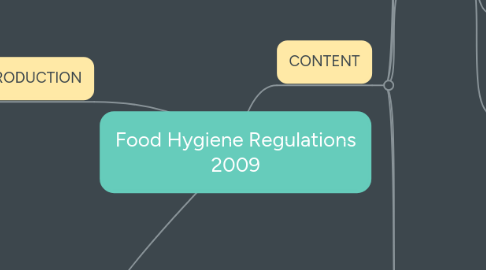
1. CONCLUSION
1.1. if they fail to follow the regulation- fine to a sentence not more than RM10,000 or imprisonment not more than 2 YEARS
2. INTRODUCTION
2.1. Background of study
2.1.1. to control hygiene & safety of food sold in the country to look after public health
2.2. Content
2.2.1. Part II (Registration of Food Premises)
2.2.2. Part III (Conduct & Maintenance of Food Premises)
2.2.3. Part IV (Food Handler)
2.2.4. Part V (Special Requirements in Handling, Preparing, Packing, Serving, Storing & Selling of Specific Food)
2.2.5. Part VI (Carriage of Food)
2.3. Significance of study
2.3.1. to emphasize proper hygiene in food premises & importance of following the regulations
2.3.2. to figure out reasons of why several issues occurred related to the regulation
2.4. Objective of study
2.4.1. to figure out the issues related to each part of the regulations
2.4.2. to emphasize the importance of maintaining proper hygiene in food premises
3. GROUP MEMBERS: 1) Zafirah bt Mohd Zaifurizan (2017760343) 2) Nuradila bt Abdul Aziz (2017758457) 3) Nurin Izzati bt Ahmad Suhaimi (2017944203)
4. CONTENT
4.1. Part II
4.1.1. Regulation (3): Food premises to be registered
4.1.1.1. -Food manufacturers, caterers, premises where food is prepared, processed, stored or served for sale as well as vehicles that sell ready-to-eat food
4.1.2. Regulation (4): Application of registration
4.1.2.1. -Shall be made to the Director with complete requirements
4.1.3. Regulation (5): Certificate of registration
4.1.3.1. -Will be given upon the completion of the application
4.1.4. Regulation (6): Validity of certificate
4.1.4.1. -3 years from the date of its issuance
4.1.5. Regulation (7): Application for renewal certificate
4.1.5.1. -Shall be made at least 30 days before its due date
4.1.6. ISSUE
4.1.6.1. -Standardize rules for food truck in term of food hygiene and safety, rent fees, food prices and suitable locations
4.2. Part III
4.2.1. Regulation (14): Water supply
4.2.1.1. -Food premises need sufficient amount of water and the water need to free from contamination
4.2.2. Regulation (15): Cleanliness of food premises
4.2.2.1. -Food premises shall be free from any accumulation of boxes, tin, empty bottles or rubbish
4.2.2.2. -Shall clean the food premises at least once daily
4.2.3. Regulation (16): Pest control in food premises
4.2.3.1. -Food premises shall free from any pests
4.2.3.2. -Action should be taken if there were pests spotted in food premises area
4.2.4. ISSUE
4.2.4.1. -Three food premises were closed down for 14 days and compounds were charged because of dumping waste into the public stream system
4.3. Part IV
4.3.1. Regulation (30): Food handler training
4.3.1.1. -All food handlers shall undergo food handlers training and obtain a Certificate of Food Handlers Training from institution approved by Director
4.3.2. Regulation (31):Medical examination and health condition of food handlers
4.3.2.1. -A food handler shall be medically examined and vaccinated by a registered medical practitioner
4.3.3. Regulation (35): Handling of food, appliances, etc
4.3.3.1. -Food shall not be brought into direct contact with any material or substance that may contaminate food
4.3.4. Regulation (37): Storage of food
4.3.4.1. -Food should be stored at condition -1 to 10C for chilled condition and -18C for frozen condition to control microbial growth
4.3.5. ISSUE: Two food premises were ordered to close immediately
4.3.5.1. -The food premises condition were too dirty as they were not maintained cleanliness as stated in Food Hygiene Regulations 2009
4.3.5.2. -Raw materials and prepared food were not stored properly with suitable conditions
4.4. Part V
4.4.1. Meat
4.4.1.1. Regulation (39): Preparation of meat
4.4.1.1.1. -Cleaned and disinfected after each task
4.4.1.1.2. -Maintain <15C with suitable humid condition
4.4.1.1.3. -Stored frozen meat <-18C
4.4.1.2. Regulation (40): Carriage of meat
4.4.1.2.1. -Hanging load or on racks
4.4.1.3. Regulation (41): Sale of meat
4.4.1.3.1. -Chilled -1C – 10C
4.4.1.3.2. -Refrigerate ≤10C for retail sale
4.4.1.4. ISSUE: Slaughtering poultries in wet markets
4.4.1.4.1. -Potential risk of meat contamination
4.4.2. Milk
4.4.2.1. Regulation (50): Temperature requirements
4.4.2.1.1. -Chilled fresh milk ≤6C
4.4.2.1.2. -Process milk after milking/4 hr after received with high temp.
4.4.2.2. Regulation (51): Sale of milk
4.4.2.2.1. -Chilled raw milk <4C
4.4.2.2.2. -Maintain originality
4.4.2.2.3. -Seal not tampered
4.4.2.3. ISSUE: Consumption of raw goat milk
4.4.2.3.1. -Brucellosis disease
4.5. Part VI
4.5.1. Vehicle
4.5.1.1. -Clean and good working condition
4.5.1.2. -Separate food and non-food
4.5.1.3. -No hazardous item
4.5.1.4. -Maintain required temperature and humid
4.5.1.5. -Disinfection after each task
4.5.2. Food Types
4.5.2.1. -Chilled -1C – 10C
4.5.2.2. -Frozen -18C
4.5.2.3. -Separate swine and non-swine origin
4.5.3. ISSUE: Carrying different items in the same vehicle
4.5.3.1. -Pork and non-swine origin products
4.5.3.2. -Illegal drugs and other part food products