Unlock the full potential of your projects.
Try MeisterTask for free.
Non hai un account?
Iscriviti gratis
Naviga
Mappe in primo piano
Categorie
Gestione del progetto
Affari e obiettivi
Risorse umane
Brainstorming e analisi
Marketing e contenuti
Istruzione e note
Intrattenimento
Vita
ICT
Design
Sintesi
Altro
Lingue
English
Deutsch
Français
Español
Português
Nederlands
Dansk
Русский
日本語
Italiano
简体中文
한국어
Altro
Mostra mappa intera
Copia ed edita mappa
Copia
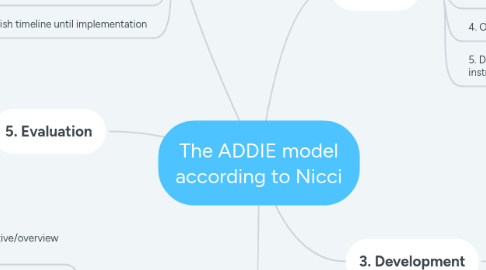
The ADDIE model according to Nicci
Istruzione e note
Nicola Dawborn
Seguire
The ADDIE model of instructional design
Iniziamo.
È gratuito!
Iscriviti con Google
o
registrati
con il tuo indirizzo email
Mappe mentali simili
Schema mappa mentale
The ADDIE model according to Nicci
da
Nicola Dawborn
1. 1. Analysis
1.1. 1. Meet with stakeholders
1.2. 2. Establish instructional objective
1.3. 3. Determine audience/student cohort
1.4. 4. Establish what is known vs. knowledge gaps in audience/learners
1.5. 5. Find out delivery options/constraints, including time availability of audience
1.6. 6. Establish timeline until implementation
2. 4. Implementation
2.1. 1. Present learning objective/overview to teachers/facilitators
2.2. 2. Train facilitators in delivery (including technology aspects and assessment)
2.3. 3. Pilot course with group of learners
2.4. 4. Iron out problems then go live on LMS
3. 5. Evaluation
3.1. This occurs at most stages of the process.
3.2. Formative: to improve/revise content and presentation of material (learners may be asked to complete surveys)
3.3. Summative: evaluates the overall effectiveness of the training - were the objectives met?
4. 2. Design
4.1. 1. Decide content based on student knowledge gaps
4.2. 2. Determine duration and pace of learning sequence, based on stakeholder needs and learning efficacy
4.3. 3. Storyboard learning sequence in PPT format
4.4. 4. Obtain storyboard feedback from stakeholders
4.5. 5. Decide/gather/purchase media/learning instruments (software, exisiting curricula etc.)
5. 3. Development
5.1. 1. Decide on graphics, colours and fonts to engage specific audience/cohort
5.2. 2. Develop lessons using chosen media, based on approved storyboard
5.3. 3. Check that original learning objectives are being met with this program - adjust/add where necessary
5.4. 3. Test material for errors with sample group of students or other stakeholders.
5.5. 4. Revise program based on feedback
Comincia. È gratis!
Connetti con Google
o
Registrati