


History of typological investigations 19-20th century
da Владимир Костюк
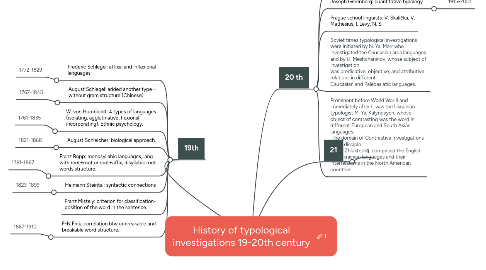
1. 19th
1.1. Frederic Schlegel: affixal and inflexional languages
1.1.1. 1772-1829
1.2. August Schlegel: added another type – without gram structure (Chinese)
1.2.1. 1767-1845
1.3. W. von Humbloldt: 4 types of languages (isolating, agglutinative, flexional, incorporating). Ethnic psychology.
1.3.1. 1761-1835
1.4. August Schleicher: biological approach.
1.4.1. 1821-1868
1.5. Franz Bopp: monosyllabic languages, lang with root+root or root+affix, disyllabic root words structure.
1.5.1. 1791-1867
1.6. Heimann Steintal: syntactic connections
1.6.1. 1823-1899
1.7. Franz Mistely: criterion for classification- position of the word in the sentence.
1.8. F-N Fink: correlation btw unbreakable and breakable word structure.
1.8.1. 1867-1910
2. 20 th
2.1. Edward Sapire. Language as a system.
2.1.1. 1884-1939
2.2. Joseph Greenberg: quantitative typology
2.2.1. 1915-2001