

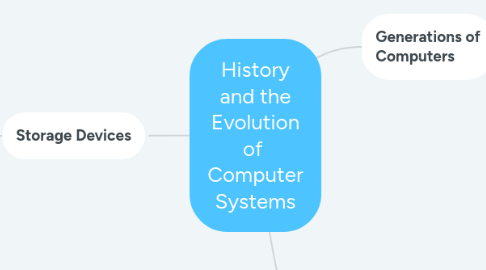
1. Storage Devices
1.1. Features
1.1.1. 1. Volatility 2. Accessibility 3. Mutability 4. Addressability
1.2. Types
1.2.1. Primary Storage
1.2.1.1. 1.Registers 2.Main Memory 3.Cache
1.2.2. Secondary Storage
1.2.2.1. Harddisk
1.2.2.1.1. ▪ Access time = seek time + rotational delay+ transfer time ▪ Seek time – track selection time (moving the head on the desired sector on the track) ▪ Rotational delay – the time it takes for the head to reach the beginning of the sector ▪ Transfer time – the time required to transfer data
1.2.3. Tertiary Storage
1.2.3.1. ▪ Typically it involves a robotic mechanism which will mount (insert) and dismount removable mass storage media into a storage device. ▪ It is a comprehensive computer storage system that is usually very slow, so it is usually used to archive data that is not accessed frequently. ▪ This is primarily useful for extraordinarily large data stores, accessed without human operators.
1.2.4. Off-line Storage
1.2.4.1. ▪ Also known as Disconnected storage ▪ Is a computer data storage on a medium or a device that is not under the control of a processing unit ▪ It must be inserted or connected by a human operator before a computer can access it again ▪ Examples ▪ Floppy Disk ▪ CD/DVD/Blue-ray ▪ USB Flash Drive ▪ Memory Cards
1.2.5. Cloud Storage
1.2.5.1. Cloud storage means storing data online. Provides greater accessibility and reliability, rapid deployment and backup
2. Generations of Computers
2.1. 1st Generation computers(1944-1955)
2.1.1. ▪ Used Thermion valves ▪ Large in size and very heavy in weight ▪ Power consumption was very high
2.2. 2nd Generation computers (1955-1964)
2.2.1. • Used transistors instead of Thermion valves. • Comparatively higher operating speed. • Size and weight of the computers decreased • Manufacturing cost reduced
2.3. 3rd Generation computers (1964-1971)
2.3.1. • Integrated Circuits (ICs) were used (A single IC has many transistors, resisters and capacitors built on a single thin slice of silicon.) • The size of the computer got further reduced • High Level Languages were developed in this generation
2.4. 4th Generation Computers (1971- Present )
2.4.1. ▪ Personal computers were developed and IBM launched ▪ the Power PC and Pentium introduced the 8088 and 8086 microprocessors. ▪ It uses large scale Integrated Circuits (LSIC) built on a single silicon chip called microprocessors.
2.5. 5th Generation Computers (Present and Beyond)
2.5.1. • Fifth generation computing devices, based on Artificial Intelligence (AI). • Are still in development, though there are some applications, such as voice recognition. • The use of parallel processing and superconductors is helping to make artificial intelligence a reality.