


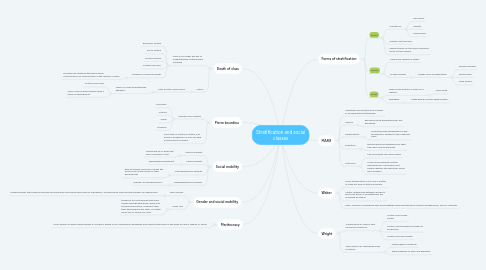
1. Death of class
1.1. Class is no longer the key to understanding contemporary societies
1.1.1. Economic factors
1.1.2. Social factors
1.1.3. Political factors
1.1.4. GLOBALIZATION
1.1.5. Increase in consumer power
1.1.5.1. societies are stratified through cultural consumption not class position in the division of labor.
1.2. Critics
1.2.1. John Scott & Lydia Morris
1.2.1.1. There is a need to distinguish between:
1.2.1.1.1. Actual social class
1.2.1.1.2. Social class in which people have a sense of belonging to
2. Pierre bourdieu
2.1. We have four capitals
2.1.1. Economic
2.1.2. Cultural
2.1.3. Social
2.1.4. Symbolic
2.2. Each type of capital is related, and being in possession of one can help in the pursuit of others.
3. Social mobility
3.1. Vertical mobility
3.1.1. movement up or down the socio-economic scale
3.2. Lateral mobility
3.2.1. geographical movement
3.3. Inter generational mobility
3.3.1. how far people move up or down the social scale in the course of their working lives
3.4. Intergeneraytional mobility
3.4.1. mobility across generations.
4. Gender and social mobility
4.1. Glass ceiling
4.1.1. invisible barrier that prevents women and minorities from being promoted to managerial- and executive-level positions within an organization.
4.2. Glass cliff
4.2.1. tendency to place women who have broken through that glass ceiling into precarious positions, making it likely their performance will falter, as if they are at risk of falling off a cliff.
5. Meritocracy
5.1. social system in which advancement in society is based on an. individual's capabilities and merits rather than on the basis of family, wealth, or social.
6. Forms of stratification
6.1. Estate
6.1.1. Consists of
6.1.1.1. The clergy
6.1.1.2. Nobility
6.1.1.3. Commoners
6.1.2. Nobility own the land
6.1.3. Peasants work on the land to produce profit for the nobility
6.2. Slavery
6.2.1. People are owned by others
6.2.2. Modern slavery
6.2.2.1. Hidden form of exploitation
6.2.2.1.1. Forced marriage
6.2.2.1.2. Forced labor
6.2.2.1.3. Child slavery
6.3. Caste
6.3.1. One’s social position is given for a lifetime
6.3.1.1. Since birth
6.3.2. Apartheid
6.3.2.1. Caste based on racial identification
7. MARX
7.1. Capitalists and proletariat are always in an exploitative relationship
7.2. Surplus
7.2.1. Excessive profit generated from the proletariat
7.3. Pauperization
7.3.1. Increasing impoverishement of the proletariat in relation to the capitalist class.
7.4. Alienation
7.4.1. workers become alienated from their own labor and its products.
7.5. Criticisms
7.5.1. The communist revolution failed
7.5.2. Class consciousness must be developed for a revolution! but people identify less with their social class position.
8. Weber
8.1. social stratification is not only a matter of class but also of status and party.
8.2. Status: differences between groups in the social honor or prestige they are accorded by others.
8.3. Party: a group of individuals who work together because they have common backgrounds, aims or interests.
9. Wright
9.1. 3 dimensions of control over economic resources:
9.1.1. control over money capital
9.1.2. control over the physical means of production
9.1.3. control over labor power.
9.2. Two factors can distinguish class locations:
9.2.1. relationship to authority
9.2.2. the possession of skills and expertise