
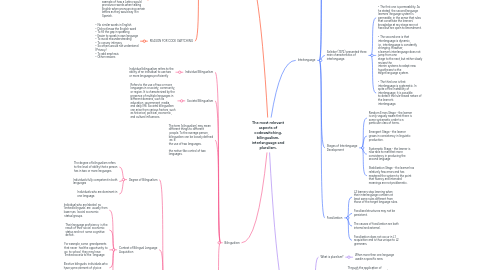
The most relevant aspects of codeswitching, bilingualism, interlanguage and pluralism.


1. Code-Switching
1.1. Intra-Sentential switching
1.1.1. Is changing the language of one sentence or phrase. Tag switching is inserting a tag from one language to another one. Using the first language or code-switching can make the acquisition of a second language easier
1.1.2. What is intersentential switching examples? Inter-Sentential: code-switching occurs when the switch of the language is done at sentence boundaries. This type of code-switching is mostly used between fluent bilingual speakers. For example: If I'm late to the appointment, pues, ni modo
1.2. Tag switching
1.2.1. Is the switching of either a tag phrase or a word, or both, from one language to another, (common in intra-sentential switches).
1.2.2. In Spanish-English switching one could say, "Él es de El Salvador y así los criaron a ellos, you know." ("He's from El Salvador, and they raise them like that, you know.")
1.3. Intra Lexical Code switching
1.3.1. This kind of code mixing occurs within a word boundary involving a change in pronunciation.
1.3.2. Example of this is when Spanish/Latino people say an English word but modify it to Spanish phonological structure. Listen to the voice clip, it gives an example of how a Latino would pronounce words when talking English when pronouncing certain letters as they would say it in Spanish.
1.4. REASON FOR CODE SWITCHING
1.4.1. • No similar words in English • Did not know the English word • To fill the gap in speaking • Easier to speak in own language • To avoid misunderstanding • To convey intimacy • So others would not understand (Privacy) • To add emphasis • Other reasons
2. Bilingualism
2.1. Individual Bilingualism
2.1.1. Individual bilingualism refers to the ability of an individual to use two or more languages proficiently
2.2. Societal Bilingualism
2.2.1. Refers to the use of two or more languages in a society, community, or region. It is characterized by the presence of multiple languages in different domains, such as education, government, media, and daily life. Societal bilingualism can arise from various factors, such as historical, political, economic, and cultural influences.
2.3. The term ‘bilingualism’ may mean different things to different people. To the average person, bilingualism can be loosely defined as: b the use of two languages. the native-like control of two languages.
2.4. Five important variables in relation to bilingualism:
2.4.1. Degree of Bilingualism
2.4.1.1. The degree of bilingualism refers to the level of ability that a person has in two or more languages.
2.4.1.2. Individuals fully competent in both languages
2.4.1.3. Individuals who are dominant in one language.
2.4.2. Context of Bilingual Language Acquisition
2.4.2.1. Individual who are labeled as ‘limited bilinguals’ are usually from lower ses (social economic status)groups.
2.4.2.2. Their language proficiency is the result of their social economic status and not some cognitive deficit.
2.4.2.3. For example, some grandparents that never had the opportunity to go to school, they may have limited access to the language
2.4.2.4. Elective bilinguals: individuals who have some element of choice about learning a second language.
2.4.2.5. Circumstantial bilinguals: individuals who have no choice about learning a second language; indigenous colonized or minority groups.
2.4.3. Age of Acquisition
2.4.3.1. Sensitive age for language learning : We have a superior language learning capacity early in life which will disappear or decline with maturation. According to many, learning a second language becomes more difficult when you are adult. Learning a second language may be easier as a child. However there are some exceptions.
2.4.4. Domains of Use
2.4.4.1. Interlocutors: a language relationship tends to evolve naturally. And once established, it is usually not easy to alter
2.4.4.2. Place or Location: work vs. home; physical location like neighborhoods
2.4.4.3. Topic: language of technical discourse or cooking, gardening, etc.
2.4.5. Social Orientation
2.4.5.1. Attitudes of bilinguals toward their bilingual status.
2.4.5.2. Attitudes toward the larger community
3. Interlanguage
3.1. Selinker described interlanguage as:
3.1.1. • Intermediate states (or intermediate grammars) of a learner’s language as it moves toward the target L2. • Creative process, driven by inner forces and interaction, and influenced by L1 and input from the target language.
3.2. Difference from both L1 and L2 / TL
3.2.1. L1: A system that has a structurally intermediate status between the native and target language. It is a system based upon the best attempt of learners to provide order and structure to the linguistic stimuli surrounding them
3.2.2. L2/TL: It is neither the system of the native language nor the system of the target language, but instead falls between the two. By a gradual process of trial and error and hypothesis testing, learners slowly and tediously succeed in establishing closer and closer approximations to the system used by native speakers of the language.
3.3. Selinker (1972) presented three main characteristics of interlanguage.
3.3.1. • The first one is permeability. As he stated, the second language learners’ language system is permeable, in the sense that rules that constitute the learners’ knowledge at any stage are not fixed but are open to amendment.
3.3.2. • The second one is that interlanguage is dynamic, i.e., interlanguage is constantly changing. However, a learner’s interlanguage does not jump from one stage to the next, but rather slowly revises the interim systems to adapt new hypotheses to the target language system.
3.3.3. • The third one is that interlanguage is systematic. In spite of the instability of interlanguage, it is possible to detect the rule-based nature of the learner’s interlanguage.
3.4. Stages of Interlanguage Development
3.4.1. Random Errors Stage - the learner is only vaguely aware that there is some systematic order to a particular class of items.
3.4.2. Emergent Stage - the learner grows in consistency in linguistic production.
3.4.3. Systematic Stage - the learner is now able to manifest more consistency in producing the second language
3.4.4. Stabilization Stage - the learner has relatively few errors and has mastered the system to the point that fluency and intended meanings are not problematic.
3.5. Fossilization
3.5.1. L2 learners stop learning when their interlanguage contains at least some rules different from those of the target language rules.
3.5.2. Fossilized structures may not be persistent.
3.5.3. The causes of fossilization are both internal and external.
3.5.4. Fossilization does not occur in L1 acquisition and is thus unique to L2 grammars.
4. Pluralism
4.1. What is pluralism?
4.1.1. When more than one language usedin a specific area.
4.2. Multicultural
4.2.1. Through the application of multicultural education concepts, we can strive to create more inclusive classrooms and schools in which our students can see themselves in the curriculum.
4.3. What is culture?
4.3.1. The way our ancestors speak through us. What binds us together. Learned traditions, loyalties, beliefs, customs that guide behavior of a group of people.
4.4. Assimilation and Pluralism
4.4.1. Assimilation is a process in which formerly distinct and separate groups come to share a common culture and merge together socially.
4.4.2. Pluralism, on the other hand, exists when groups maintain their individual identities. In a pluralistic society, groups remain separate, and their cultural and social differences persist over time.
4.5. Linguistic pluralism usually refers to the condition that exists when a community or country officially recognizes more than one language. For example, the Indian constitution recognizes fifteen national languages.
4.5.1. Linguistic pluralism is common: most of the two hundred or so nations of the world use more than one of the five thousand or so languages spoken on this planet.