
Types of resources to support your research

Mindmap with types of suppor materials

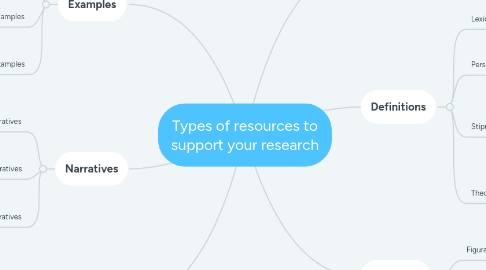
1. Examples
1.1. Good examples
1.1.1. Examples that illustrate, clairfy, reinforce, support or complement the idea.
1.2. Bad examples
1.2.1. Example of what not to do can be useful to explain the faults in a process.
1.3. Nonexamples
1.3.1. Examples of what something is not. For example, "your Adobe Acrobate update is not considered an emergency."
1.4. Best examples
1.4.1. or Best Practices, presents the best way to do a process or the desired outcome of a situation.
2. Narratives
2.1. Informative narratives
2.1.1. Stories which intention is to make information more memorable. For example, the (fake) story about Newton and the apple.
2.2. Persuasive narratives
2.2.1. Stories with the purpose of persuading. For example, telling your story as a victim of abuse to raise awarness about it.
2.3. Entertaining narratives
2.3.1. Narratives with the sole purpose of entertaining. Think a stand-up comedian. Not very relevant to Informative or Persuasive speeches.
3. Testimony
3.1. Expert testimony
3.1.1. Information provided by renowned figures or experts in a topic. Quotes from peer-reviewed journals could be considered in this category since most of these writter are experts on their fields.
3.2. Eyewiteness testimony
3.2.1. Given by someone directly related to the situation or event being presented.
4. Facts and statistics
5. Definitions
5.1. Lexical
5.1.1. Also known as "dictionary" definitions
5.1.2. Also known as "dictionary" definitions
5.2. Persuasive
5.2.1. Repackaging a phrase to make ir more or less appealing. For example, oil drilling -> energy exploration.
5.3. Stipulatives
5.3.1. Definitions coined by those who discovered them. For example, Nils Bejerot coined "Stockholm synrome" to the psychological response of a hostage or abused bonding with their captor or abuser.
5.4. Theoretical
5.4.1. Used to define abstract concepts. They try to give an overall global definition. For example, how would you define peace? or love?
6. Analogies
6.1. Figurative analogies
6.1.1. Analogies where we compare words from different classes. For example, the airplane is an eagle.
6.2. Literal analogies
6.2.1. Analogies where we compare words from the same class. For example, "this fast-food restaurant is the next McDonalds".