
GenAI for CIS Controls

How to make your security program more effective and efficient using Generative AI.

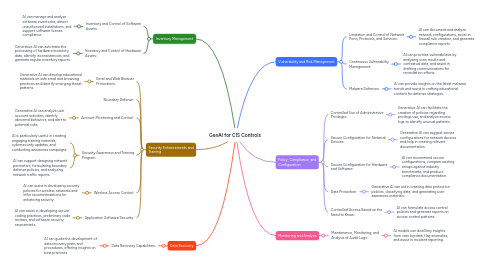
1. Inventory Management
1.1. Inventory and Control of Software Assets:
1.1.1. AI can manage and analyze software inventories, detect unauthorized installations, and support software license compliance.
1.2. Inventory and Control of Hardware Assets:
1.2.1. Generative AI can automate the processing of hardware inventory data, identify inconsistencies, and generate regular inventory reports.
2. Security Enhancements and Training
2.1. Email and Web Browser Protections:
2.1.1. Generative AI can develop educational materials on safe email and browsing practices and identify emerging threat patterns.
2.2. Boundary Defense:
2.3. Account Monitoring and Control:
2.3.1. Generative AI can analyze user account activities, identify abnormal behaviors, and alert to potential risks.
2.4. Security Awareness and Training Program:
2.4.1. AI is particularly useful in creating engaging training materials, cybersecurity updates, and conducting awareness campaigns.
2.4.2. AI can support designing network perimeters, formulating boundary defense policies, and analyzing network traffic reports.
2.5. Wireless Access Control:
2.5.1. AI can assist in developing security policies for wireless networks and offer recommendations for enhancing security.
2.6. Application Software Security:
2.6.1. AI can assist in developing secure coding practices, preliminary code reviews, and software security assessments.
3. Data Recovery
3.1. Data Recovery Capabilities:
3.1.1. AI can guide the development of data recovery plans and procedures, offering insights on best practices.
4. Vulnerability and Risk Management
4.1. Limitation and Control of Network Ports, Protocols, and Services:
4.1.1. AI can document and analyze network configurations, assist in firewall rule creation, and generate compliance reports.
4.2. Continuous Vulnerability Management:
4.2.1. AI can prioritize vulnerabilities by analyzing scan results and contextual data, and assist in drafting communications for remediation efforts.
4.3. Malware Defenses:
4.3.1. AI can provide insights on the latest malware trends and assist in crafting educational content for defense strategies.
5. Policy, Compliance, and Configuration
5.1. Controlled Use of Administrative Privileges:
5.1.1. Generative AI can facilitate the creation of policies regarding privilege use, and analyze access logs to identify unusual patterns.
5.2. Secure Configuration for Network Devices:
5.2.1. Generative AI can suggest secure configurations for network devices and help in creating relevant documentation.
5.3. Secure Configuration for Hardware and Software:
5.3.1. AI can recommend secure configurations, compare existing setups against industry benchmarks, and produce compliance documentation.
5.4. Data Protection:
5.4.1. Generative AI can aid in creating data protection policies, classifying data, and generating user awareness materials.
5.5. Controlled Access Based on the Need to Know:
5.5.1. AI can formulate access control policies and generate reports on access control patterns.
6. Monitoring and Analysis
6.1. Maintenance, Monitoring, and Analysis of Audit Logs:
6.1.1. AI models can distill key insights from vast log data, flag anomalies, and assist in incident reporting.